
Digital infrastructure investing sounds like a single theme. It is not. A data center campus, a carrier hotel, a tower portfolio, a middle-mile fiber route, and a dense urban small-cell network may all sit under the same label, but they do not earn returns the same way, and they do not fail for the same reasons.
That distinction matters even more now that AI has pushed physical constraints back to the center of the story. In April 2026, the International Energy Agency reported that electricity demand from data centers rose 17% in 2025 and highlighted grid connections, transformers, gas turbines, and advanced chips as real expansion bottlenecks. In other words, demand is not the hard part anymore. Converting demand into dependable, profitable capacity is.
TL;DR
- Digital infrastructure is really a collection of different asset classes with different economic engines.
- The strongest investments usually control a hard-to-replicate bottleneck: energized data center capacity, interconnection density, tower location, fiber rights-of-way, or scarce urban pole access.
- Data centers should be evaluated on power, cooling, customer mix, and network value, not just land or square footage.
- Towers, fiber, and small cells can all benefit from rising connectivity demand, but lease structure, build cost, and tenant concentration vary widely.
- A useful first-pass test is to ask what is scarce, what is sticky, what requires major reinvestment, and which outside dependency can delay returns.
WarningThis is sector analysis, not personalized investment advice. In digital infrastructure, debt structure, valuation, tax treatment, contract terms, and project timing can change the investment case dramatically.
These assets are connected, but their economics are not
A useful starting point is to separate digital infrastructure by what actually gets monetized. Some assets sell powered capacity. Some sell access to a location. Some sell route density and backhaul. Some sell low-latency exchange between networks and clouds. The headline trend may be the same – more data and more computing – but the cash flow logic is different.
| Asset type | What the customer is really buying | Typical source of pricing power | What most often threatens returns | Signals worth watching |
|---|---|---|---|---|
| Wholesale or hyperscale data centers | Large blocks of powered capacity | Power availability, land control, utility relationships, development pipeline | Grid delays, cost overruns, customer concentration, cooling retrofits | Energized megawatts, pre-leasing quality, utility delivery dates, capex per MW |
| Retail colocation and interconnection facilities | Proximity to networks, clouds, and trading partners | Carrier neutrality, ecosystem density, switching costs, cross-connect revenue | Competitive build-outs, aging plant, pricing pressure if network value weakens | Interconnection growth, churn, cabinet utilization, power density upgrades |
| Macro towers | A high-value vertical location for radio equipment | Scarce sites, zoning barriers, co-location economics, long leases | Carrier consolidation, churn, amendment pressure, limited incremental tenancy | Net tenant adds, churn, renewal spreads, carrier concentration |
| Fiber and middle mile | Reliable route capacity between important endpoints | Rights-of-way, route uniqueness, dense local demand, anchor contracts | Overbuild, weak route economics, expensive maintenance, slow take-up | On-net buildings, route overlap risk, renewal rates, construction discipline |
| Small cells and edge nodes | Targeted wireless capacity close to users | Dense urban placement, permitting access, attached fiber, hard-to-replace street furniture | Long deployment cycles, municipal delays, customized build costs, slow ramp | Booked nodes vs. revenue-generating nodes, fiber utilization, tenant amendments |
This is why digital infrastructure should not be treated as a monolithic bet on “more internet.” A company can be exposed to a good demand trend and still be a mediocre investment if it needs too much new capital, depends on too few customers, or lacks control over the actual bottleneck.
Use the Bottleneck-Durability Test before you chase growth
A simple way to evaluate the space is to run every opportunity through what can be called the Bottleneck-Durability Test. It is not a formal industry standard. It is a practical editorial framework for deciding whether an asset benefits from real scarcity or just borrowed excitement.
- Scarcity: What hard-to-replace thing does the asset control? In this sector, the answer might be energized land, a dense interconnection ecosystem, a permitted tower site, a unique fiber route, or municipal access that competitors cannot replicate quickly.
- Expandability: Can revenue grow with incremental additions, or does every growth step require another expensive build? Co-location on an existing tower is very different from developing another 100 megawatts of data center capacity.
- Stickiness: Why would a customer stay? The strongest answers are operational disruption, network effects, latency needs, or physical relocation cost, not just a contract expiration date.
- Concentration: Who pays the rent, and how lumpy is that revenue? A portfolio with a few giant customers can still work, but it deserves different risk assumptions than a diversified interconnection platform.
- Dependency: Which outside system can break the thesis? Utilities, permits, spectrum policy, rights-of-way, contractor availability, and financing costs often matter as much as raw demand.
This test helps investors avoid a common mistake: confusing a strong end market with a durable owner advantage. Many digital assets serve growing demand. Far fewer own a bottleneck that remains scarce after the next build cycle.
Data centers: power and interconnection matter more than sheer size
Data centers attract most of the attention because they sit closest to cloud expansion and AI training and inference. But investors should resist two shortcuts: valuing facilities mainly by square footage and assuming every announced campus is comparable once a tenant shows interest.
Hyperscale and wholesale campuses are really power businesses
In the current market, land without timely power is not the same as capacity. The IEA’s 2026 update made that plain by pointing to slow grid connections and equipment bottlenecks as constraints on new data center supply. Digital Realty’s 2025 Form 10-K also warned that power and cooling systems are difficult and expensive to upgrade or expand, especially as AI workloads become more power-intensive. For investors, that means the critical questions are not only where the site is and how large it is, but when utility service is actually deliverable, how much of that capacity is contracted, and what incremental spending is required to make the site AI-ready.
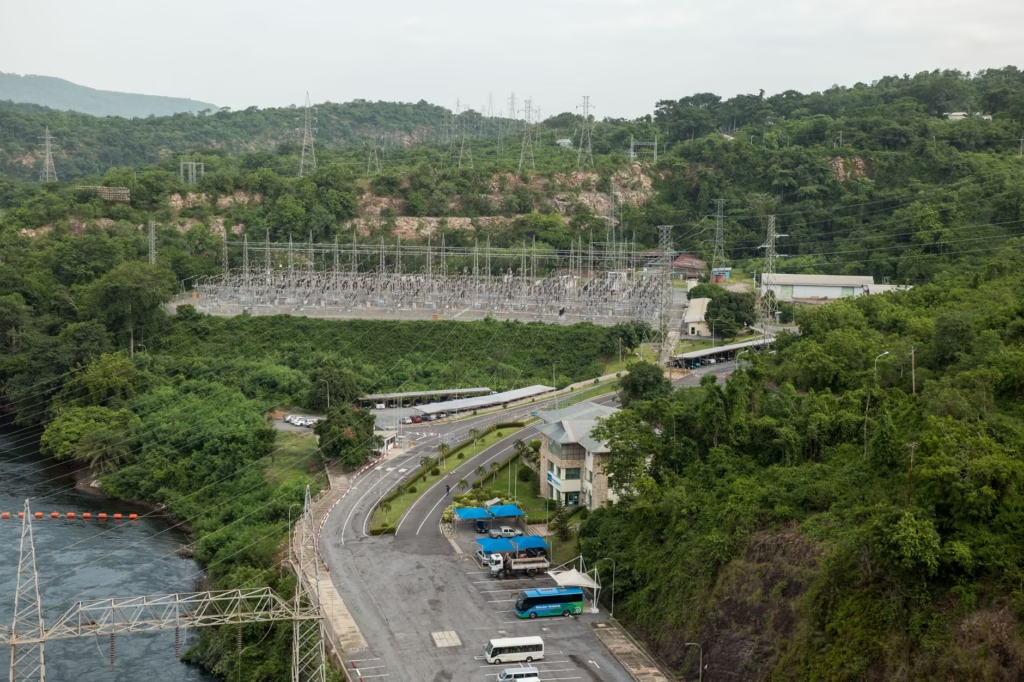
This is also where concentration risk enters. A hyperscale build leased to a handful of major customers can produce excellent economics, but it can also create lumpier renewals, tougher bargaining power, and more exposure to customer capital-spending cycles. An investor is often underwriting both the asset and the tenant strategy.
Retail colocation and interconnection rely on ecosystem depth
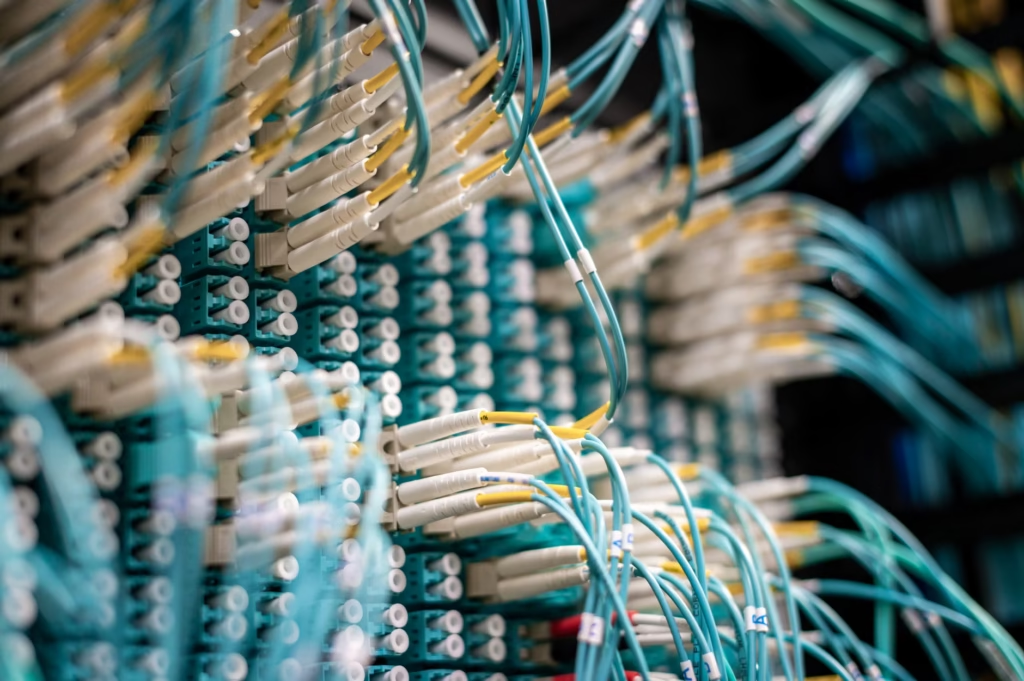
Retail colocation is different. Here, the value is not only power and cooling but also proximity. As Equinix states in its 2025 Form 10-K, enterprises are shifting toward third-party facilities for outsourced infrastructure and interconnection, and its ecosystem creates a network effect that can improve performance and lower cost for customers. That kind of network effect can produce genuine stickiness. A facility connected to clouds, carriers, enterprise customers, and trading or content partners may be much harder to replace than a generic powered shell.
The practical implication is that a smaller, carrier-dense interconnection asset can deserve a very different valuation logic than a larger, less connected data hall. Investors should pay attention to cross-connect activity, customer diversity, cabinet utilization, latency-sensitive demand, and whether the site functions as a magnet that pulls in additional tenants rather than merely houses equipment.
What usually breaks the data center thesis
- Announced capacity is treated as if it were energized, permitted, and financeable today.
- Older facilities are assumed to be easy AI conversions even when power density or cooling upgrades may be expensive.
- Customer quality is judged by brand names alone rather than by contract structure, term, and diversification.
- Investors ignore water, backup power, and local utility constraints until they become a timetable problem.
Networks and connectivity: towers, fiber, and small cells require different underwriting
The connectivity side of digital infrastructure can look steadier than data centers, but it still deserves careful separation. The International Telecommunication Union’s Facts and Figures 2025 says 5G now reaches more than half of the global population and accounts for more than one-third of mobile broadband subscriptions. That is a supportive usage backdrop. It is not a shortcut to valuation.
Macro towers usually work because extra tenants are highly profitable
Towers are often the cleanest example of infrastructure operating leverage. Once a site is built and permitted, additional tenants or equipment amendments can be attractive because the underlying vertical real estate is already in place. American Tower’s 2025 Form 10-K says its sites typically host more than one tenant and that lease arrangements generally carry initial non-cancellable terms of five to ten years. Those are useful traits, but they do not make every tower portfolio equally strong. Location quality, remaining co-location capacity, local zoning difficulty, and carrier concentration still matter a great deal.
A mature tower portfolio can disappoint if most of the easy co-location upside has already been captured or if carrier consolidation reduces future amendments. Towers tend to look simple from a distance. Up close, the difference between a scarce, well-sited asset and a merely adequate one can be material.

Fiber is about route quality and endpoints, not bragging rights on miles
Fiber assets are especially easy to oversimplify. Long-haul, metro, enterprise, and middle-mile fiber do not behave the same way. NTIA defines middle mile as broadband infrastructure that does not connect directly to an end-user location, and the agency says its purpose is to reduce the cost of connecting unserved or underserved areas to the internet backbone. For investors, that means the real question is not how many route miles a company can advertise. It is whether those routes connect valuable endpoints and whether competitors can economically overbuild them.
The strongest fiber networks often connect carrier hotels, cloud on-ramps, data centers, towers, campus clusters, or enterprise-rich corridors where incremental connections can compound the value of the route. The weakest are capital-intensive builds with thin take-up assumptions, weak anchor tenancy, or routes that are not meaningfully differentiated once a better-financed rival shows up.
Small cells and edge assets can be useful, but they are rarely tower clones
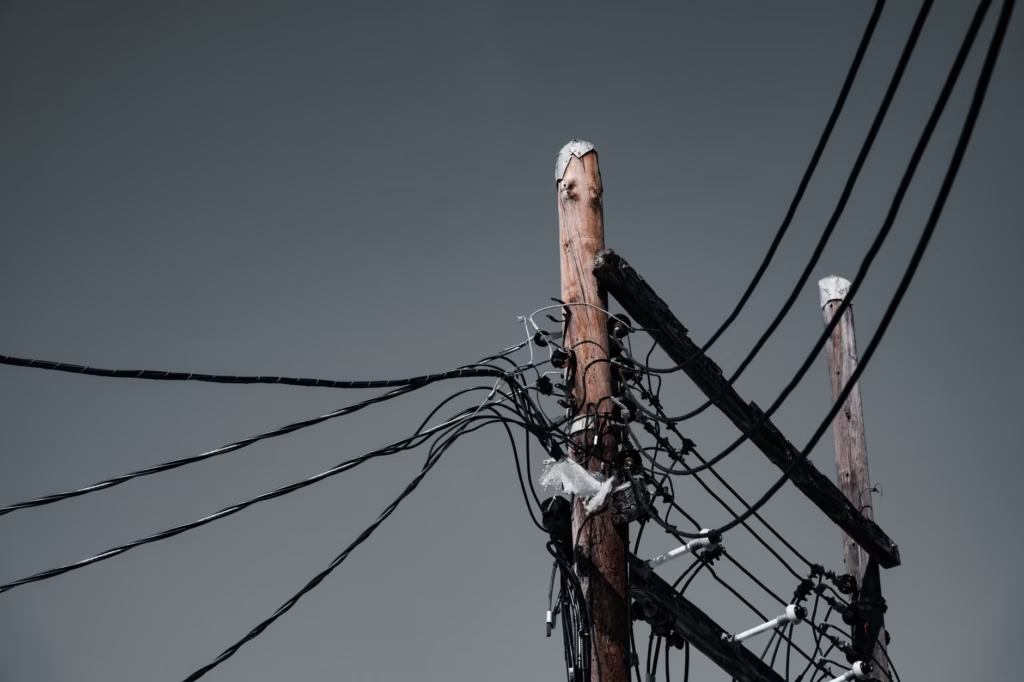
Small cells often require more customized deployment, more street-level permitting, and more attached fiber than macro towers. That can create strategic value in dense urban corridors, stadium districts, and other traffic-heavy locations, but it can also lengthen the payback period. Crown Castle’s 2025 Form 10-K illustrates the scale of the category, with more than 40,000 towers, approximately 105,000 small cell nodes generating revenue or under contract, and approximately 90,000 route miles of fiber. Even at that scale, the economics of a tower lease and a small-cell deployment are not interchangeable.
A good habit here is to separate booked nodes from revenue-generating nodes, and to separate contractual visibility from construction reality. A large pipeline can be encouraging, but it is not the same as installed, accepted, and billing infrastructure.
A hypothetical comparison shows how quickly the risk shifts
Consider a hypothetical example. Opportunity A is a greenfield AI campus marketed around a huge future megawatt figure on inexpensive land. Opportunity B is a carrier-neutral metro facility with lower headline growth, existing power, dense fiber access, and established interconnection revenue. A may offer the larger upside if utility delivery, cooling design, equipment procurement, and tenant commitments all land on schedule. B may deserve the higher present value if its bottlenecks are already controlled and its customer ecosystem is difficult to replicate. The better question is not which asset sounds more futuristic. It is which underwriting case depends on fewer external miracles.
Common mistakes investors make in digital infrastructure
- Treating demand growth as equivalent to owner pricing power.
- Comparing asset classes by a single metric such as square footage, route miles, or tower count.
- Ignoring maintenance and upgrade capex, especially for cooling, backup power, fiber upkeep, and equipment amendments.
- Underestimating tenant concentration because the tenants are large, familiar companies.
- Assuming public enthusiasm for AI automatically improves project economics.
- Looking past the balance sheet even though these are capital-heavy, often rate-sensitive businesses.
A practical monitoring checklist after you invest
- Start with live capacity, not announced capacity. Track energized megawatts, revenue-generating nodes, contracted tower amendments, and actual on-net connections.
- Review how growth is being purchased. Compare incremental revenue opportunity with the capex required to deliver it.
- Watch customer concentration and renewal behavior. A diversified rent roll can matter as much as top-line growth.
- Follow external dependencies closely, especially utility interconnection timing, permitting, contractor availability, and equipment lead times.
- Re-test the moat every few quarters. Ask whether the asset is becoming more central to its customers or easier to bypass.
- Keep financing discipline in view. Maturity ladders, floating-rate exposure, and development commitments can reshape risk faster than sector demand trends.
The real opportunity is durable scarcity
Digital infrastructure can be an attractive long-term investing theme, but durable returns usually come from owning scarcity that remains scarce after the headlines fade. In data centers, that may be timely power, cooling readiness, and dense interconnection. In towers, it is site quality and co-location economics. In fiber, it is route uniqueness and valuable endpoints. In small cells, it is hard-won urban placement tied to usable fiber. Investors who focus on those specifics are usually asking the right questions. Investors who stop at the theme are usually still too early in the work.
FAQ
Are data centers and telecom towers the same kind of investment?
Not really. Both are infrastructure-like assets, but their revenue drivers differ. Data centers often depend on power delivery, cooling design, and tenant fit-out. Towers depend more on location scarcity, co-location capacity, and carrier leasing behavior. They can both benefit from digital growth while reacting very differently to capex cycles and customer concentration.
Is AI automatically bullish for every data center owner?
No. AI can increase demand, but it also raises the bar for power density, cooling, and utility access. A company with weak power availability or expensive retrofit needs may not benefit as much as the headline trend suggests.
What matters more in fiber investing: miles or route quality?
Route quality. Fiber becomes much more valuable when it connects scarce or high-demand endpoints such as data centers, cloud access points, enterprise corridors, wireless towers, and campus clusters. Raw route miles by themselves can be misleading.
Do small cells replace macro towers?
Usually they complement them. Macro towers provide broad coverage, while small cells are often deployed to add targeted capacity in dense locations where traffic is concentrated. Their economics, deployment timelines, and permitting risks are also different.
How can a non-specialist investor analyze this sector without becoming an engineer?
Start with a disciplined checklist: identify the bottleneck the asset controls, review tenant concentration, study lease and contract terms, examine capex requirements for growth, and look for outside dependencies such as utility delivery or municipal permits. Public filings and regulatory materials often reveal more than marketing decks do.
References
- International Energy Agency, Energy and AI (2025) – https://www.iea.org/reports/energy-and-ai/
- International Energy Agency, Data centre electricity use surged in 2025, even with tightening bottlenecks driving a scramble for solutions – https://www.iea.org/news/data-centre-electricity-use-surged-in-2025-even-with-tightening-bottlenecks-driving-a-scramble-for-solutions?__cf_chl_f_tk=mPlSI9KgDo0inioCRhuh6kU7U80qA.4CGq1WWVhvZcU-1783084545-1.0.1.1-072zjVfFsXXPnHR.edts3ccVzFC5OHDol3NSdHt3s8Y
- Equinix, 2025 Form 10-K – https://www.sec.gov/Archives/edgar/data/1101239/000110123926000032/eqix-20251231.htm
- Digital Realty Trust, 2025 Form 10-K – https://www.sec.gov/Archives/edgar/data/1297996/000110465926015365/dlr-20251231x10k.htm
- American Tower Corporation, 2025 Form 10-K – https://www.sec.gov/Archives/edgar/data/1053507/000105350726000035/amt-20251231.htm
- Crown Castle Inc., 2025 Form 10-K – https://www.sec.gov/Archives/edgar/data/1051470/000105147026000016/cci-20251231.htm
- National Telecommunications and Information Administration, Enabling Middle Mile Broadband Infrastructure Program – https://www.ntia.gov/funding-programs/internet-all/enabling-middle-mile-broadband-infrastructure-program
- International Telecommunication Union, Facts and Figures 2025 – https://www.itu.int/itu-d/reports/statistics/facts-figures-2025/
