
convertible debt can result in dilution, an obligation to make a cash payment, or both. The key determinant of risk is the flexibility in the instrument regarding how the company can settle a conversion, not how little interest is charged. Dilution risk remains whether the company pays a low interest rate or no interest. In fact, given the cash obligations of conversion, the company may need to raise additional equity.[1][2]
Picture me, in an imagined example, reading the financing announcement over a cooling coffee. “0.00%” looks comfortable, but I need to consider the settlement terms on the next page. I get annoyed at how much confidence I placed in that one little number. Rather than label the notes “cheap financing,” I wrote the maturity date, possible cash payments, and the coupon.
Start with what the company can deliver
As a more concrete example, consider Datadog’s December 2024 issuance of $1 billion of 0.00% convertible senior notes due December 1, 2029. The initial conversion price was 4.5955 shares for every $1,000 principal, or roughly $217.60 a share. That means for the issuance there are 4.5955 million reference shares prior to any adjustments. No interest is clearly inexpensive financing, but it’s not truly free financing. There are some cash payments and the conversion option has some value.[1][2]
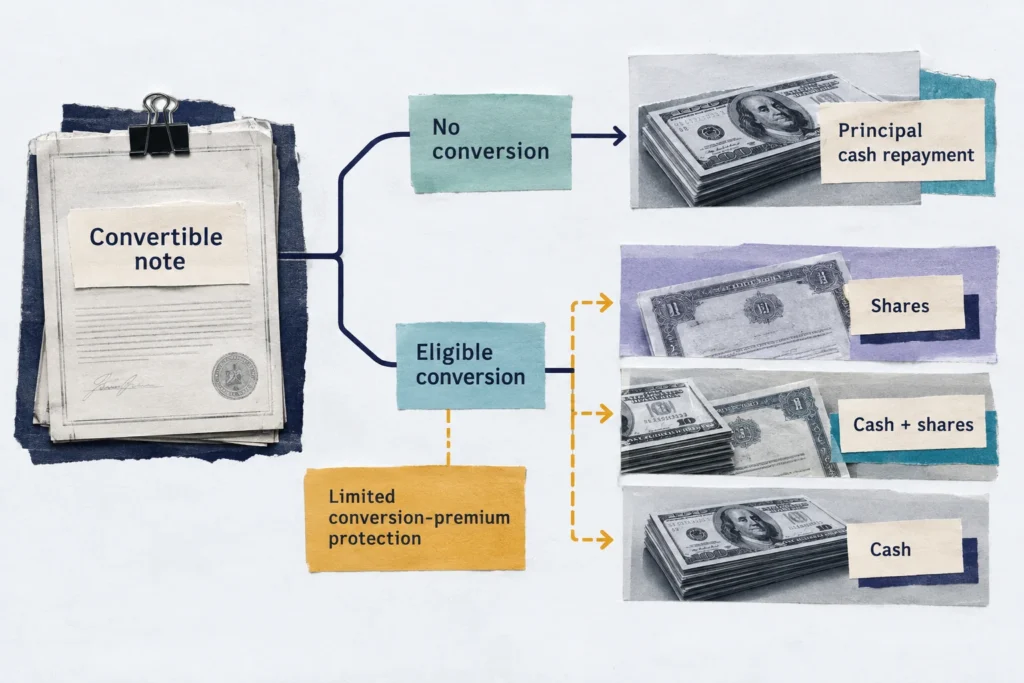
Holders can convert when the contract allows; Datadog chooses the settlement method (cash, shares, or a combination). The default is a combination settlement with $1,000 cash per $1,000 principal. That default does not mean Datadog will repay the principal in cash. This distinction is important. Converting to shares would preserve cash, and a principal cash payment would require $1 billion even if the stock is performing well.[2]
A share price above $217.60 doesn't immediately enable Holders to convert. One early-conversion route requires the stock to exceed 130% of the conversion price, initially about $282.89, on at least 20 of 30 specified trading days, with eligibility assessed under the contract’s quarterly rules. Other conditions exist as well. From September 1, 2029, all of the above conditions will be eliminated. I discuss the importance of “conversion would be valuable” versus “conversion is available today.”[2]
One financing, several very different cash bills
Assume unchanged initial terms and conversion in an eligible window. For cash-based settlements, assume every relevant daily volume-weighted average price is the stated price. At $300, the reference conversion value is 4.5955 million × $300 = $1.37865 billion. Paying principal in cash leaves a $378.65 million premium, equivalent to approximately 1.2622 million shares. Actual observation-period prices can change those amounts.[1][2]
| Outcome | Cash paid to noteholders | Gross shares issued | Assumed capped-call benefit | Exposure after matched hedge |
|---|---|---|---|---|
| No conversion; $150 at maturity | $1 billion principal | None | None | $1 billion cash payment |
| All-share conversion; $300 | None | 4.5955 million | $378.65 million equivalent | About 3.3333 million net share-equivalents |
| Cash principal, shares for premium; $300 | $1 billion | About 1.2622 million | $378.65 million equivalent | $1 billion cash; approximately zero net premium shares |
| All-cash conversion; $300 | $1.37865 billion | None | $378.65 million equivalent | $1 billion net cash cost |
| Cash principal, shares for premium; $400 | $1 billion | 2.0955 million | About $481.50 million equivalent | $1 billion cash plus about 0.8918 million net premium share-equivalents |
The capped call protects upside, not principal
Datadog spent $100.9 million on capped calls with an initial strike price of approximately $217.60 and a cap of $322.38. Think of it as a hedge to protect against conversion value above the call price, within a specific price range. The hedge does not deliver the value itself. That is why the $300 mixed-settlement example can result in approximately zero net premium dilution, but still require approximately $1 billion in cash.[3][4]
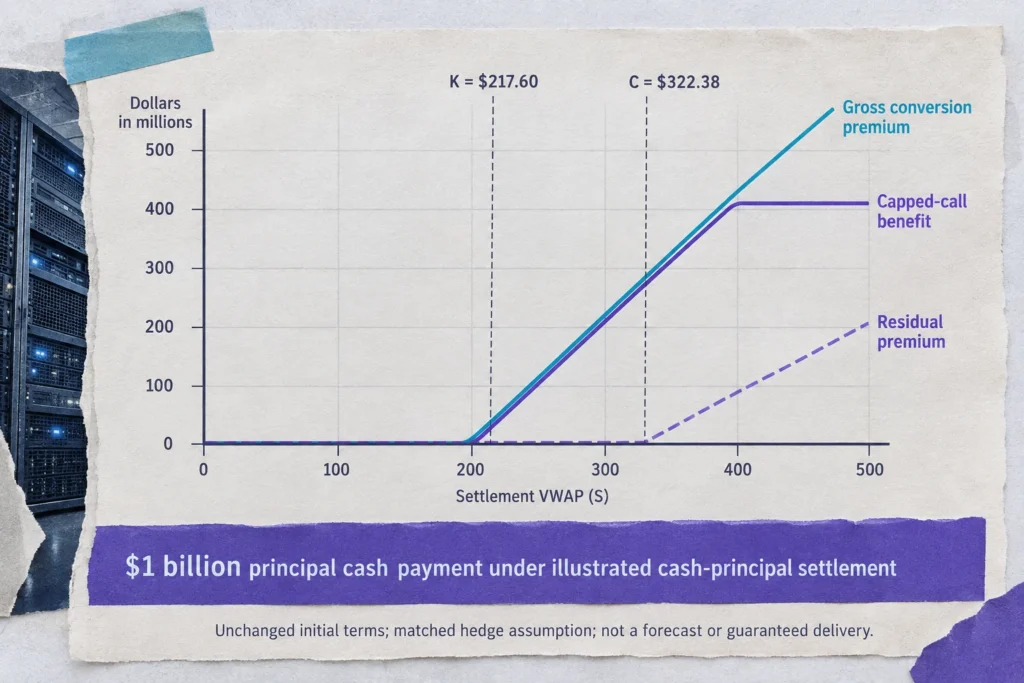
Also, the hedge does not eliminate all-share conversion dilution under the cap. At $300, for example, the dilution is equivalent to $1 billion / $300 = approximately 3.3333 million shares. Above $322.38, the protection does not vanish; its benefit does not increase. At $400, the simplified maximum benefit is about $481.50 million, leaving approximately $356.70 million of uncovered premium, or 0.8918 million share-equivalents.[2][3][4]
I think the hedge is a useful tool, but a guaranteed share buyback it is not. The actual results depend on the terms of the settlement, observational prices, adjustments, termination, and performance of the counterparty. The table expresses equivalent economic protection to Datadog.[4]
When conversion doesn’t happen, the calendar wins
At a $150 maturity price, for example, conversion would be economically unattractive, and the principal of $1 billion remains due. Certain changes outside of management's control can also give the holders the right to repurchase shares before maturity. The low coupon does not change the principal repayment.[2]
Datadog’s June 30, 2026 filing reported approximately $435 million in cash and $4.6 billion in marketable securities. That is substantial liquidity relative to these notes, but it’s a dated snapshot, not a reserved 2029 repayment fund. Future cash generation, operating needs, acquisitions, and other maturities belong in the comparison. The notes’ roughly $985.545 million net accounting carrying value also doesn’t change the $1 billion contractual principal.[5]
Refinancing moves the obligation; it doesn’t erase it. If a company borrowed the full $1 billion at a hypothetical 7% cash coupon, annual interest would become $70 million, before fees. Replacement financing might instead carry another conversion option or require equity issuance. I’d test the cash payment without assuming new funding, then separately model the cost of funding it. Neither access nor painless pricing is assured.
Give each claim one place in your valuation
There are three legitimate share counts. The initial reference is 4.5955 million. The other share count is diluted EPS. Approximately 4.596 million shares of the notes were included in the denominator for the second quarter of 2026. Antidilutive capped-call contracts were excluded. The settlement you model determines your valuation denominator. Neither of the two mentions of shares forecasts shares issuance.[1][5]
Under US GAAP, how shares are settled matters. Management can have a cash settlement preference; that doesn’t change the treatment of the contract. The settlement clause states cash is allowed. Diluted EPS doesn’t change that. The cash settlement option allows shares to be removed from the diluted EPS calculation. Because cash is allowed, that treatment is different from a contract that requires cash. For that reason, I prefer to read the settlement clause before using the reported denominators.[6]
Here’s my thinking around the settlement-date valuation. Let A = business value + cash, other debt, before settlement, and N = shares outstanding. Consider the hedge later. Repayment = (A, $1 billion) / N; all-share conversion = A / (N + 4.5955 million). At a $300 settlement price, cash principal with shares for the premium = (A, $1 billion) / (N + 1.2622 million), and all-cash conversion = (A, $1.37865 billion) / N.[1][2]
Accounting for the hedge: add cash to the numerator or reduce the ownership claim with respect to share-delivery. The upfront cost of the hedge is already captured, if cash is used after that payment to settle A. Refinancing requires the same treatment. New borrowing adds cash and a offsetting liability before settlement; cash out flow pays off the old claim, but leaves the new debt. Don’t net both debts after the old one has been satisfied. These are settlement-date reconciliations, not a present-value estimate of Datadog’s fair value.[3][4]
In your modeling, a share conversion is equal and offset by principal repayment. This ensures a double charge does not happen to shareholders. I want your caution in your valuation to come from the business’s actual exposure. The principal question becomes, could the company be viable to take on expensive replacement financing, if the stock never makes conversion attractive?
Sources and references
- Datadog, Inc.; SEC EDGAR: Datadog Form 8-K describing the completed December 2024 offering (2024-12-12)
- Datadog, Inc.; SEC EDGAR: Indenture for Datadog's 0.00% Convertible Senior Notes due 2029 (2024-12-12)
- Datadog, Inc.; SEC EDGAR: Datadog 2024 Form 10-K, convertible-note and capped-call disclosures
- Datadog, Inc.; SEC EDGAR: Datadog form of capped-call confirmation filed with the issuance (2024-12-12)
- Datadog, Inc.; SEC EDGAR: Datadog Form 10-Q for the quarter ended June 30, 2026
- Deloitte: Deloitte EPS Roadmap, convertible debt settled in cash or common stock
