

Before incorporating contracted megawatts into an outdated revenue forecast, tie them to a particular phase, the remaining delivery obligations for that phase, and the billing trigger for that contract. A signature is not evidence of demand, and does not mean that power is available to be used or that monthly fees have commenced. I’d prefer to leave the start date uncertain, and not use large contracted megawatts to disguise what is still to be funded by the shareholders.
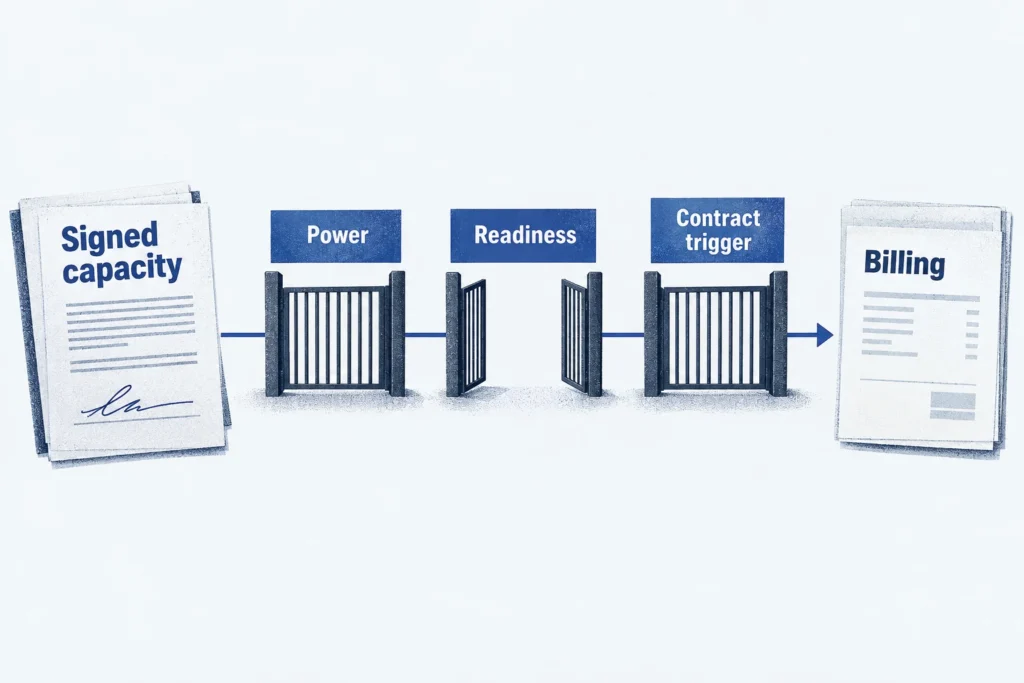
I like to imagine I’m at Starbucks and see a positive capacity announcement about a large customer commitment. I feel good about that. Later, on my laptop, I see that the second phase still requires approval. So much for the clean headline. While my coffee is still warm, I make a point to distinguish the phases in my notes.
Which megawatts did the company actually announce?
The operator’s definitions can save you a lot of guesswork. Core Scientific’s July 2026 presentation counts executed customer commitments as leased customer power regardless of service commencement. Its billable customer power requires service commencement and active billing. Estimated leasable power is different again: potential customer capacity isn’t necessarily commissioned capacity. Those are Core Scientific’s definitions, not standardized industry labels.[1]
Also ask where the power is measured. Utility supply, total facility power and customer IT load are not interchangeable. Cooling and other infrastructure consume power before you reach the computing equipment. The Department of Energy defines PUE as the ratio of total facility energy to IT equipment energy. That annual ratio does not guarantee deliverable IT megawatts. I don’t use assumed PUEs to convert utility power to customer capacity or to compare to a competitor’s IT load.[6]
One contract, two phases, different forecast credit
Digi Power X’s Cerebras project illustrates why I’d separate the phases. Its filing for the quarter ended June 30, 2026 stated Phase 1 would be 15 MW and an additional, conditional 25 MW in Phase 2, and aim to achieve both by December 15, 2026 and the first fiscal quarter of 2027, respectively. As targets, both had a ways to go. Like the 25 MW, the remaining conditions and a later date determined the completion of Phase 2.[3]
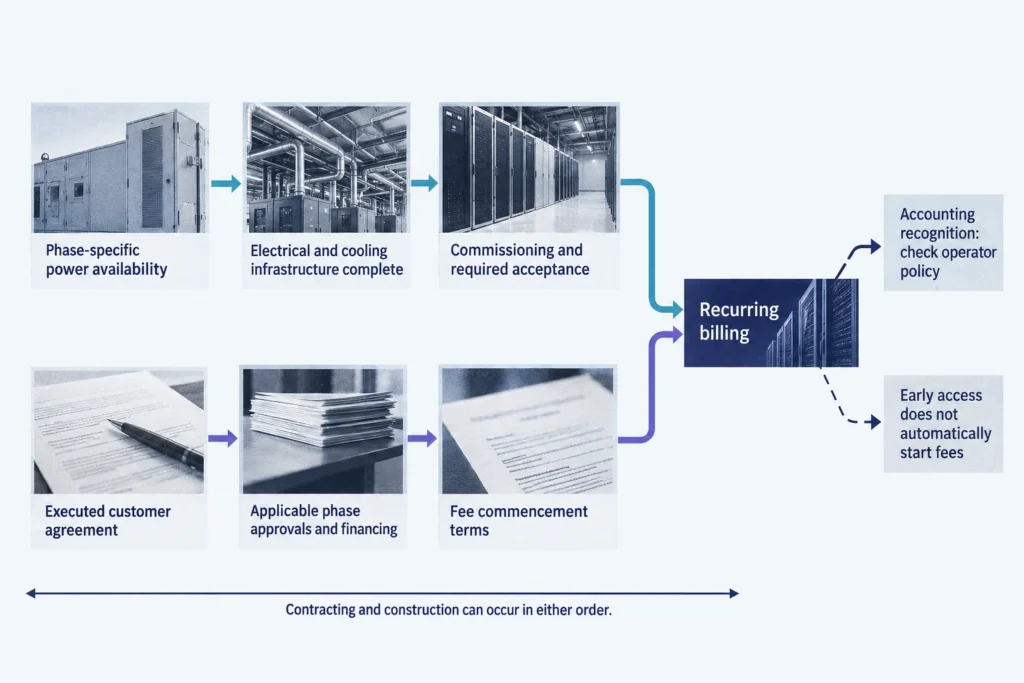
We can give them credit for real progress. The filing reported the completion of Phase 1’s substation infrastructure, and final interconnection to the grid. As of June 30, the facility was still under construction, and the company stated a need for project financing. Completed power milestones are important. They just don’t accomplish the rest of the facility. These were operator-reported milestones, without independent utility record confirmation of phase-specific full-load delivery.[3]
The next point in the public agreement states that phase fees are set based on the conditions of the plant ready for service (RFS) and are charged upon commissioning and customer inspection. Allowing early access does not initiate the assessment of recurring fees. Delivery-related termination rights mean that the signature does not eliminate the risk of delivery. There are missing deadlines, particular specifications and commercial mechanics, which mean that I can identify these risks, but I cannot assign them a specific cancellation probability.[2]
You can still assess the size of the commitment. At the disclosed $195 per kW per month fee, the 15,000 kW in Phase 1 means that, upon fulfillment of the conditions, including financing and the approval of the customer, Phase 1 would generate a gross capacity fee of $2.925 million per month. Evidence that the phases have met the conditions set out in the contracts and financing and the approval of the customer would make the commitment dated. More announcements of the total number of megawatts would not change the commitment.[2][3]
A running server and a paying customer aren’t the same milestone
A picture of some servers can mislead you in either direction. Servers on-site can reflect early access. Low server utilization does not mean that a customer would not pay. In Digi Power X, a take-or-pay provision means that for committed capacity, the customer would pay even if the computing resources are not utilized. I would focus on payment triggers, rather than on server utilization.[2]
Differences between the first invoice and the first accounting revenue are still possible. Digital Realty’s 2025 Form 10-K states that rental recognition occurs upon assessment of the property’s readiness to be put to the intended use and upon possession or control of that use, subject to the company’s accounting policy and collectibility. Also, note that contractual straight-line rent may differ from the amounts actually received. For your forecasts, consider the following points: (a) recognized rents may not be contractual rents, (b) recurring billings and cash receipts may not be synchronous, and (c) lease policy may not be applicable to all of the company’s services contracts.[5]
Shareholders still fund the waiting period
There is a funding side to the waiting period. Digital Realty’s second quarter 2026 supplemental report provides estimates for completion, leased percentage, and current and future development investment separately. Prior to combining these, ensure that the boundaries of their ownership shares are the same. Its nine-month weighted-average signing to contractual commencement lag applies to the new-lease cohort for the quarter under consideration and not to all other projects you are forecasting.[4]
Equinix’s filing for the quarter ended June 2026 states that $6.1 billion of the Company’s unaccrued contractual capital commitments (primarily equipment and labor) for expansion projects are payable within 12 months. This is portfolio-wide and not related to an individual uncommenced lease. What is concerning is that construction payments may be due prior to customer billings.[7]
What I’d put beside the revenue start date
- Which capacity? Record the facility, phase, measurement date, ownership share, and whether the megawatts mean utility supply, facility power, or customer IT load.
- What remains to deliver? Identify the power scope and availability date, unfinished construction, commissioning, and required customer acceptance.
- What determines when the customer is allowed to leave? Identify recurring-fee events, conditional phase approvals, take-or-pay events, outside delivery deadlines, delay and termination remedies.
- Who fills the financing gap and who pays after? Identify any commitment for funding, legal customer, and disclosed guarantees. Multiple phases for the same customer are not independent demand bets.
- What would change your demand forecast? Identify the conditions that are preventing you from making a demand forecast.
For Digi Power X, I’d look for a subsequent Phase 1 update documenting applicable financing and approvals, completed readiness procedures, and recurring-fee commencement before calling it billable. The Phase 2 date requires its own approvals and evidence of readiness to deliver. The June filing cannot establish either phase’s status on October 7, 2026. There is uncertainty, not a final conclusion that the project has failed. You can credit the signed demand without pretending you know when the bill starts.[2][3]
Sources and references
- Core Scientific: Core Scientific Second Quarter Fiscal Year 2026 Earnings Presentation, term library (2026-07-28)
- Digi Power X / SEC EDGAR: Digi Power X, Cerebras Data Center Colocation and Master Services Agreement (2026-05-08)
- Digi Power X / SEC EDGAR: Digi Power X Form 10-Q for the quarter ended June 30, 2026
- Digital Realty: Digital Realty Second Quarter 2026 Financial Supplement (2026-07-23)
- Digital Realty: Digital Realty 2025 Form 10-K (2026-02-13)
- US Department of Energy: Cooling Water Efficiency Opportunities for Federal Data Centers
- Equinix: Equinix Form 10-Q for the quarter ended June 30, 2026
