

Look past apparent issues with credibility and see if the AI changes your investment forecast. If it does, try to locate the original data source, align with the reporting period, and check the definition for the metrics. Reproduce the calculations and test the explanations. I wouldn’t throw away a helpful summary because of a single (possibly incorrect) sentence. Likewise, I wouldn’t accept a correct number as justification for a (possibly unsupported) conclusion and a change in valuation.
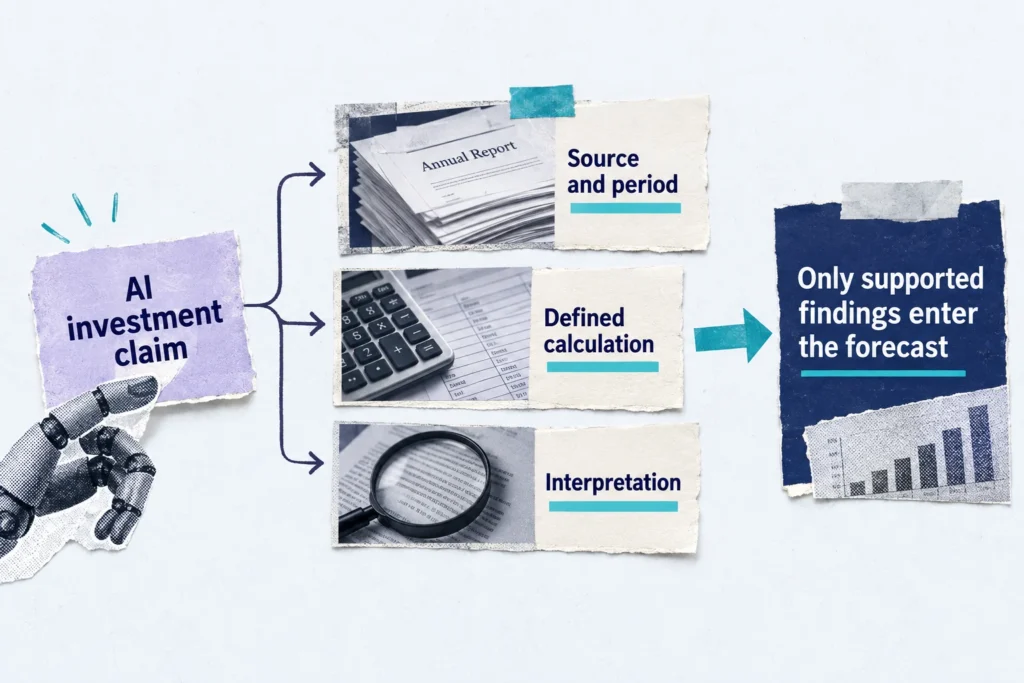
Imagine I’m reading an AI stock summary with a spreadsheet open and ten minutes before dinner. I’m trying to get my cash-flow forecast as high as possible. I see “improving cash conversion” and think, “yes!” But then I see I need to track down some supporting info in a pdf. The number is good, and the explanation is probably good, but I’m not doing the analysis it suggests. Instead, I am leaving my forecast as is, and will only adjust it once the number and explanation have survived a check.
One real answer, with an incomplete evidence trail
The example is an externally archived Dewey research response: FinanceBench item 00591 in its Config B results, using claude-opus-4-6 at exhaustive research depth. It cites Adobe’s fiscal 2022 cash conversion, but I’m not going to copy and paste it. The documented publication context is April 2026, but the exact day it was generated isn’t known. The tool had a FinanceBench-derived PDF collection, and the preserved record doesn’t show exactly what it was retrieving. The example reaches a conclusion for the cash conversion, justifying it with a growth comparison. This is something that is probably worth investigating, but not something we can base our conclusions about the potential and future of AI research in general.[1][2][4]
A citation can exist without supporting the sentence
I will address three questions: is the cited document extant? can I locate the cited document? does the location of the cited document support the claim? In this case, the cited document could exist and the format of the citation may be correct and the claim may still be incorrect. Citation format is not an accounting control.
We don't have access to the source objects returned by the execution code. This makes it impossible to align the citations shown in the answer with their source targets, thus leaving a provenance gap. This is not evidence of invented citations. In this case, we may be able to verify the claim made, but that does not validate the citations.[1][3]
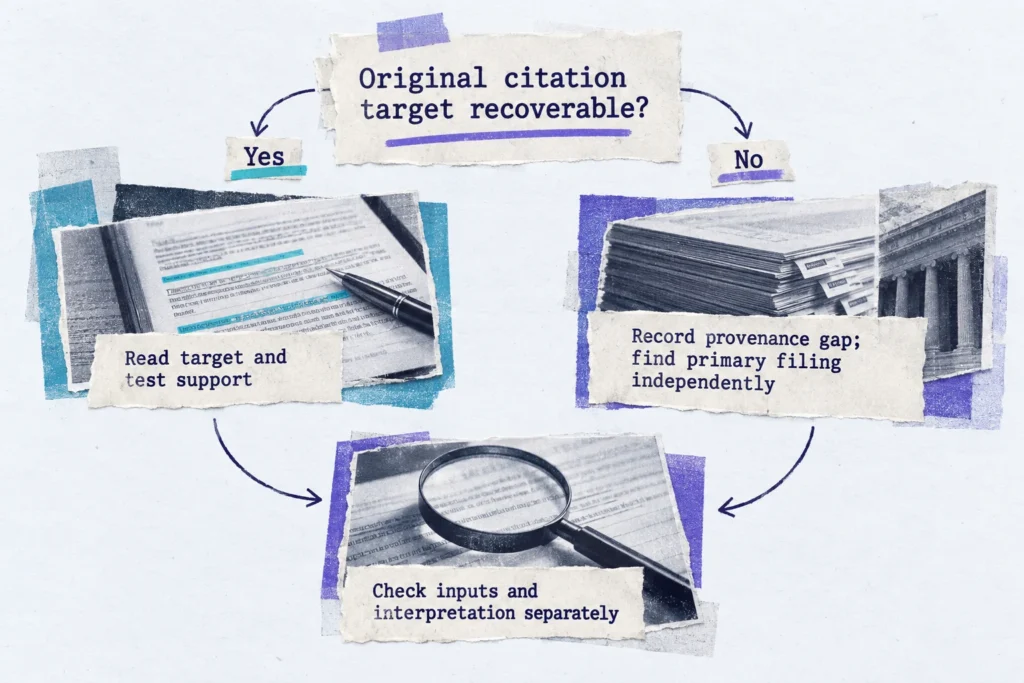
If you are writing your own summary, open the cited source rather than having another model validate the answer for you. Check the quoted company name, filing date, report and period covered, and the quoted passage itself. Fabricated citations are not proven simply because the link is broken.
Match the year before touching the calculator
The cited Form 10-K for Adobe is accession 0000796343-23-000007, filed January 17, 2023, for the fiscal year ended December 2, 2022. Report periods end on the last day of the month. Keep in mind, reporting is done for a previous period, so a filing date in 2023 is for a fiscal year ending in 2022. This distinction may catch outdated or misaligned numbers before they are used to support a growth story. This filing supports the claim about Adobe, not the latest financial condition of Adobe.[5]
See Items 8 and 7, respectively, for financial statements/footnotes and management’s discussion and analysis, to clarify the respective roles. Keep the two roles distinct. A reported balance is a statement fact. Management’s account of what drove it is an attributed explanation, not proof, of a durable trend.[8]
The ratio checks out, but define it first
For this audit, cash conversion refers to operating cash flow, less purchases of property and equipment, divided by GAAP net income. That is an analytical definition. The SEC states that free cash flow is also undefined. If your AI summary references that definition, check what was subtracted from operating cash flow, not whether the result sounds good.[9]
Adobe’s cash-flow statement on printed page 57 reports operating cash flow of $7,838 million in FY2022 and $7,230 million in FY2021. Property-and-equipment purchases were $442 million and $348 million. Use those expenditure amounts, not total investing cash flow. The income statement on printed page 54 reports GAAP net income of $4,756 million and $4,822 million. All these inputs are consolidated annual figures in millions.[6]
- FY2022: ($7,838, $442) ÷ $4,756 × 100 = 155.51%.
- FY2021: ($7,230, $348) ÷ $4,822 × 100 = 142.72%.
- Change: 155.51%, 142.72% = approximately 12.79 percentage points.
Those are independently reproducible calculations. The historical improvement survives. Notice, though, that net income fell while the cash numerator rose; both affect the ratio. A higher conversion percentage isn’t, by itself, an explanation of better business economics.[6]
The supporting explanation doesn’t survive
Here’s where I’d stop trusting the explanation. The archived answer suggests operating cash flow outpaced Digital Media revenue, but ($7,838 ÷ $7,230-1) × 100 gives operating cash flow growth of 8.41%. Adobe’s earnings release reports 11% Digital Media revenue growth and 12% consolidated revenue growth. Cash flow grew more slowly than either. And comparing consolidated cash flow with one segment’s revenue can’t tell you that segment’s cash performance.[1][6][7]
There are reported and adjusted revenue and earnings growth, and GAAP and Non-GAAP earnings in the release. Distinctions need to be made when numbers are presented next to each other. Using adjusted earnings to replace Net income changes the question your ratio answers, it doesn't resolve the original comparison.[7]
It's not an either-or case where the entire answer has to be accepted or discarded. I'd accept the verified historical ratio, remove the contradicted growth rationale, and keep the long-run conversion assumptions. It takes cash flow reconstruction to examine the cash flow performance of a segment, and that's beyond the scope of two-year analysis. Inputs were provided in the filing, and the answer was clear about not having them. Missing the reconstruction of a cash flow statement doesn't mean company disclosure is missing.[1][6]
What I’d save beside the forecast
There are only a few audit records, and the original response can be returned unedited. Save the outputs and locations with the edits. You don't need to repeat the entire company analysis, you just have to know which part earned a place in your thesis.
| Claim or issue | Source location and period | Verification result | Unresolved uncertainty | Consequence for the thesis |
|---|---|---|---|---|
| Original citation support | Config B item 00591 and execution code; April 2026 publication context | Original citation targets aren’t recoverable from the preserved record. | Exact generation day and retrieved passages. | Record the gap; don’t claim the original citations were validated. |
| Cash conversion improved | FY2022 10-K, printed pages 54 and 57; FY2022 versus FY2021 | 155.51% versus 142.72%, up 12.79 percentage points under the stated formula. | Economic cause of the improvement. | Retain the defined historical result. |
| Cash-flow growth outpaced revenue | 10-K page 57 and FY2022 earnings release, annual highlights | Contradicted: 8.41% versus 11% Digital Media and 12% consolidated revenue growth. | Segment cash performance isn’t isolated. | Remove this explanatory support. |
| Improvement will persist | FY2021, FY2022 statement comparison | Not established by this audit. | Recurring drivers, timing effects, and subsequent performance. | Don’t raise long-run conversion assumptions on this evidence alone. |
Sources and references
- Dewey: Archived Dewey Config B output, FinanceBench item 00591
- Dewey: Dewey FinanceBench evaluation and original publication context (2026-04)
- Dewey: Evaluation execution code
- Dewey: Document-ingestion code
- SEC: Adobe FY2022 EDGAR filing detail (2023-01-17)
- Adobe: Adobe FY2022 Form 10-K (2023-01-17)
- Adobe, furnished through SEC EDGAR: Adobe Q4 and fiscal 2022 earnings release (2022-12-15)
- SEC: How to Read a 10-K
- SEC: Non-GAAP Financial Measures, Question 102.07 (2022-12-13)
