
TL;DR
- Treat AI as a value chain, not a single trade. Different funds and stocks define AI exposure in very different ways. (globalxetfs.com)
- Look for evidence in filings, revenue, contracts, capex, and margins, not just AI language. SEC officials have warned against generic AI buzz and AI washing. (sec.gov)
- Themed ETFs can be useful, but read the prospectus, holdings, fees, spreads, and premiums or discounts to NAV before buying. (investor.gov)
- Infrastructure matters. Official energy agencies tie AI growth to data centers, electricity demand, and physical buildout. (eia.gov)
- A broad, diversified core is often the cleanest way to get AI exposure without turning one exciting theme into an oversized portfolio risk. (investor.gov)
AI is one of those themes where the technology story and the stock story can diverge for long stretches. The IMF has argued that AI could lift productivity and growth, and OECD research also points to meaningful long-run productivity gains. But both sources stress uncertainty around adoption, distribution of benefits, and the conditions required for those gains to spread across the economy. That is the central investing problem: a technology can be genuinely important and still be a poor investment if the market price already assumes years of near-perfect execution. (imf.org)
This article is general information, not personalized investment, tax, or legal advice. Any dedicated AI allocation should fit your goals, time horizon, tax situation, and tolerance for large drawdowns.
A real technology wave can still produce bad investments
A useful first distinction is this: AI adoption can be real even when many AI-labeled securities are overpriced, low-quality, or only loosely connected to the economic value being created. Investors often collapse those two ideas into one. They hear that AI is transforming business and jump straight to assuming the most visible AI stocks must therefore be compelling buys. That leap is where hype does the damage. The better question is not whether AI matters. It is where profits are likely to accrue, how durable they are, and what expectations are already embedded in the price.
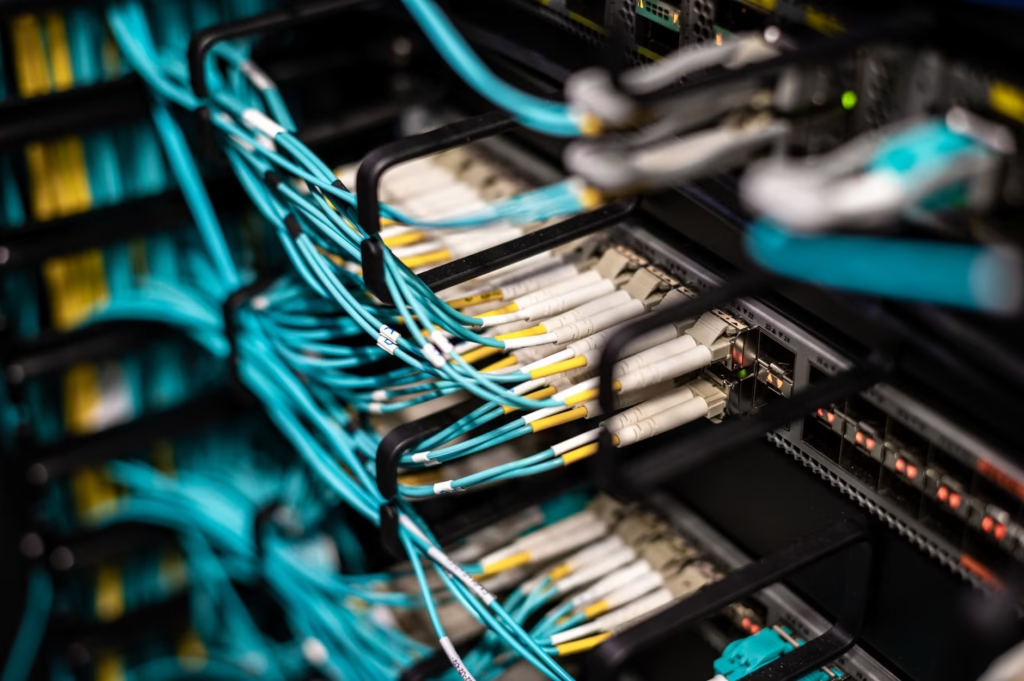
One reason AI is more than a buzzword is that the physical buildout is measurable. The International Energy Agency ties AI deployment directly to electricity use in data centers, and the U.S. Energy Information Administration projects rising data-center server electricity use as AI servers account for a larger share of installed stock. That does not tell investors which stock will win. It does tell them that AI demand has real infrastructure dependencies, real capex needs, and real bottlenecks. (iea.org)

Start with the AI value chain, not the loudest ticker
The simplest way to avoid hype is to stop thinking of AI as a single bucket. Even official fund descriptions show how broad the theme is. Global X AIQ says it targets companies benefiting from AI and hardware used for AI-enabled big data analysis, while iShares ARTY describes exposure across software, infrastructure, and services. If two mainstream AI funds define the opportunity this differently, investors should assume the theme is heterogeneous rather than precise. (globalxetfs.com)
- Compute and networking. Chips, memory, foundries, servers, and networking gear may benefit when AI training and inference spending rises, but these businesses can also be cyclical and capital-intensive.
- Power, cooling, and data-center infrastructure. Less glamorous than model demos, but often essential when capacity is tight and electricity demand is rising.
- Software and tools. This includes data platforms, developer tools, security, copilots, workflow software, and enterprise platforms trying to turn AI features into recurring revenue.
- Adopters. Some ordinary businesses may never market themselves as AI plays, yet they may use AI to improve productivity, service levels, or margins. Those can be better investments than the obvious theme stocks when valuations are calmer.
Use the Four-Question Reality Check
Before buying any AI-linked stock or fund, run a simple screen. Call it the Four-Question Reality Check. It is not a forecasting model. It is a discipline for pulling the conversation away from headlines and back toward business substance.
1. Where in the AI chain does this company actually get paid?
This question filters out a surprising amount of noise. A company that sells critical compute, networking, or power-management equipment has very different economics from a company that simply adds an AI assistant to an existing product. Look for disclosed revenue sources, segment detail, usage-based pricing, backlog, or identifiable customers. SEC staff has said companies discussing AI should clearly define what they mean, focus on current or proposed use that is relevant to the business, and have a reasonable basis for their claims. (sec.gov)
2. What evidence exists beyond the story?
In public markets, the cleanest evidence is not keynote excitement. It is what shows up in filings, contracts, capital spending, renewal behavior, margins, and management’s willingness to discuss risks as well as upside. The SEC has explicitly warned that AI washing may violate securities laws, and it has stressed that investor-facing AI claims need a factual basis. A company that talks about AI constantly but cannot explain how AI changes sales, costs, or competitive position is giving investors more narrative than proof. (sec.gov)
3. What is today’s price already assuming?
This is where transformative technologies often become bad stocks. If the price already assumes dominant market share, sustained pricing power, falling compute costs, abundant power, and limited competition, then even solid execution may not be enough. A practical habit is to write down, in plain English, what must happen over the next three to five years for the investment to work. If the answer requires a chain of perfect outcomes, the optimism may already be in the price.
4. What could break the thesis?
AI investing is not only about upside. It is also about fragility. Power availability, cooling needs, supply constraints, model costs, customer concentration, open-source competition, regulation, and reliability failures can all change the economics. The EIA and IEA both highlight the growing electricity footprint of data centers, which is a useful reminder that AI adoption lives inside physical systems, not just software demos. A good AI thesis should survive at least one meaningful disappointment. (eia.gov)

A portfolio can look diversified and still be one large AI bet if several funds all concentrate in the same sector or overlapping large holdings. Investor.gov notes that concentration risk can make a fund more volatile than a more diversified portfolio. (investor.gov)
Choose the investment vehicle that matches the job
| Route | What you really own | Why investors use it | Main hidden risk | Best fit |
|---|---|---|---|---|
| Broad diversified index fund | A wide mix of companies, including firms building and adopting AI | Simple, low-maintenance participation in the theme without needing to identify single winners | AI upside may be diluted by the rest of the market | Investors who want exposure without making AI a separate bet |
| Broad technology fund | A more concentrated basket of large tech and semiconductor exposure | More direct participation in major platform and infrastructure names | Sector concentration and valuation risk | Investors already comfortable with tech-heavy volatility |
| AI-themed ETF | A curated basket based on an index or manager’s definition of AI | Easier than choosing one stock and more explicit than a general tech fund | The label may hide high overlap, concentration, fees, and theme drift | Investors willing to read the methodology and holdings |
| Single infrastructure stock | A direct bet on chips, networking, cooling, power, or data-center capacity | Can be the clearest route to monetization if demand is real | Cyclicality, customer concentration, capex risk, and sharp re-rating risk | Investors comfortable analyzing company-level fundamentals |
| Single application or software stock | A bet that AI features will translate into sticky demand and better economics | Can outperform if product-market fit and pricing power are real | Hype risk is often highest here because monetization is easier to promise than prove | Investors who can separate product excitement from revenue reality |
The point of this comparison is not to declare a universal winner. It is to match the tool to the job. If the goal is simply not to miss the AI era, broad diversification is often enough. If the goal is to express a more specific view on compute, cloud capacity, or software monetization, then a smaller and more deliberate allocation makes more sense. Investor.gov explicitly notes that diversification can reduce the damage from one investment going wrong, even though it cannot prevent losses in a broad market decline. (investor.gov)
Why AI ETFs deserve more skepticism than their labels imply
The phrase AI ETF sounds more precise than it is. One fund may lean toward semiconductors and hardware. Another may spread exposure across software, infrastructure, and services. That is not a flaw. It simply means the label alone tells you very little. Before buying, read the objective and benchmark methodology, then inspect the holdings and weights. Official investor guidance also says to read the summary and full prospectus, and to check the fund website for holdings, median bid-ask spread, and historical premiums and discounts to NAV. (globalxetfs.com)
- Read the fund objective and benchmark first. The prospectus is where the fund’s objective, strategies, risks, performance, and expenses are laid out. (investor.gov)
- Open the holdings list and top weights. If most of the fund’s behavior will come from a handful of names you already own elsewhere, the theme may be adding overlap more than diversification.
- Check sector, country, and issuer concentration. A fund with many holdings can still behave like a narrow bet. (investor.gov)
- Compare fees and trading frictions against broader alternatives. ETF investors also face bid-ask spreads and possible premiums or discounts to NAV. (investor.gov)
- Decide whether you want passive index exposure or an active manager making ongoing judgment calls. Investor.gov notes that both funds and ETFs can follow active or passive strategies. (investor.gov)
- Only buy a themed fund if you would still be comfortable holding it after a deep drawdown. Themes tend to test conviction most when the headlines cool off.

Common ways investors end up buying hype
- Mistaking AI mention count for monetization. SEC guidance pushes companies toward tailored, relevant disclosure and a reasonable basis for AI claims. (sec.gov)
- Paying for a story that is still several business steps away from cash flow.
- Stacking overlap across a tech fund, semiconductor fund, AI ETF, and individual names until one theme quietly dominates the portfolio. (investor.gov)
- Ignoring the physical side of the theme, including power, cooling, and data-center capacity. (eia.gov)
- Assuming every layer of the value chain will earn exceptional margins. Some parts of the stack may become competitive or commoditized even if AI adoption keeps growing.
- Making a long-duration theme bet with money that may be needed soon. A volatile idea becomes much more dangerous when the time horizon is short.
A realistic example of disciplined AI exposure
Consider a hypothetical investor with a long time horizon who already saves through diversified funds in retirement accounts. The disciplined move is usually not to tear up that core and replace it with an AI theme. It is to keep the core intact and, only if there is a clear reason, add a small and explicit AI sleeve. That sleeve might represent a view on infrastructure spending, a belief in specific software enablers, or a preference for a themed ETF after reading the methodology. The point is not the exact percentage. The point is that the AI bet is consciously sized so a bad outcome does not derail the larger plan. That is basic diversification logic, not a lack of conviction. (investor.gov)
A useful next step is to write down three monitoring signals before buying: whether revenue or usage evidence is improving, whether management is discussing both benefits and risks in a concrete way, and whether the position has become too large simply because the price ran up. If the thesis weakens or the position grows beyond its intended role, trimming is a risk-control decision, not an admission that the original idea was foolish. SEC staff guidance on AI disclosure is helpful here because it nudges investors toward material, non-boilerplate information rather than marketing language. (sec.gov)
When the right move is no special AI allocation at all
Sometimes the most rational AI strategy is to do nothing special. A diversified portfolio already gives exposure to businesses that build AI infrastructure, adopt AI internally, or benefit from productivity gains elsewhere in the economy. That approach will not deliver the emotional appeal of a pure-play winner, but it can reduce the odds of overpaying for a crowded theme or duplicating the same risk through several overlapping products. Diversification does not eliminate market risk, but official investor guidance still treats it as a basic defense against single-basket errors. (investor.gov)
The cleanest way to invest in AI without chasing hype is to follow the economics, not the excitement. Start with the value chain. Demand evidence. Ask what the current price already assumes. Keep position size honest. And remember that a dedicated AI bet is optional. Good investing is usually less about owning every fashionable narrative and more about building a process that still makes sense after the excitement fades.
Is an AI ETF safer than a single AI stock?
Usually it carries less company-specific risk than a single stock, but it is not automatically safe. A themed fund may still be concentrated in one sector or a handful of large holdings, and ETF investors also face bid-ask spreads and possible premiums or discounts to NAV. Read the holdings and prospectus before assuming you are well diversified. (investor.gov)
Do energy and data-center infrastructure names count as AI investments?
Sometimes they do. The EIA and IEA both point to rising data-center electricity demand and the physical infrastructure required to support AI deployment. That means power equipment, cooling systems, networking gear, and related infrastructure can be economically relevant even if the company does not market itself as an AI pure play. (eia.gov)
How much of a portfolio should go into AI?
There is no universal number. It depends on existing tech exposure, goals, taxes, time horizon, and the ability to absorb sharp volatility without changing the broader plan. A practical rule is that any dedicated AI position should be small enough that a severe drawdown would be painful, but not plan-breaking.
What is the clearest sign that I am chasing hype?
If your thesis depends more on broad promises than on who pays the company, what product is being sold, how risks are disclosed, and what has to happen to justify the current price, you are probably trading a story more than an investment case. The SEC’s warnings about AI washing are a useful reminder that excitement and evidence are not the same thing. (sec.gov)
References
- IMF: AI Will Transform the Global Economy. Let’s Make Sure It Benefits Humanity – https://www.imf.org/en/Blogs/Articles/2024/01/14/ai-will-transform-the-global-economy-lets-make-sure-it-benefits-humanity
- OECD: Miracle or Myth? Assessing the Macroeconomic Productivity Gains from Artificial Intelligence – https://www.oecd.org/en/publications/miracle-or-myth-assessing-the-macroeconomic-productivity-gains-from-artificial-intelligence_b524a072-en.html
- SEC: Chair Gary Gensler on AI Washing – https://www.sec.gov/newsroom/speeches-statements/sec-chair-gary-gensler-ai-washing
- SEC: The State of Disclosure Review – https://www.sec.gov/newsroom/speeches-statements/gerding-statement-state-disclosure-review-062424
- Investor.gov: Diversify Your Investments – https://www.investor.gov/introduction-investing/investing-basics/save-and-invest/diversify-your-investments
- Investor.gov: Updated Investor Bulletin on Exchange-Traded Funds – https://www.investor.gov/introduction-investing/general-resources/news-alerts/alerts-bulletins/investor-bulletins-24
- Investor.gov: How to Read a Mutual Fund Prospectus, Part 1 – https://www.investor.gov/introduction-investing/general-resources/news-alerts/alerts-bulletins/investor-bulletins/how-read-2
- Investor.gov: Prospectus – https://www.investor.gov/introduction-investing/investing-basics/glossary/prospectus
- Investor.gov: Characteristics of Mutual Funds and Exchange-Traded Funds – https://www.investor.gov/introduction-investing/general-resources/news-alerts/alerts-bulletins/characteristics-mutual-funds-exchange-traded-funds
- Global X: Artificial Intelligence & Technology ETF (AIQ) – https://www.globalxetfs.com/funds/AIQ
- iShares: Future AI & Tech ETF (ARTY) – https://www.ishares.com/us/products/297905/ishares-robotics-and-artificial-intelligence-etf-fund
- U.S. EIA: Data Center Server Energy Use Grows Across the Commercial Building Stock – https://www.eia.gov/todayinenergy/detail.php?id=67704
