

An acquisition adds value when the total economic benefits from the purchase and integration outweigh the costs. I would separate this into two questions. First, is the existing business improving? Second, did the company pay an appropriate price for the acquisition?[8]
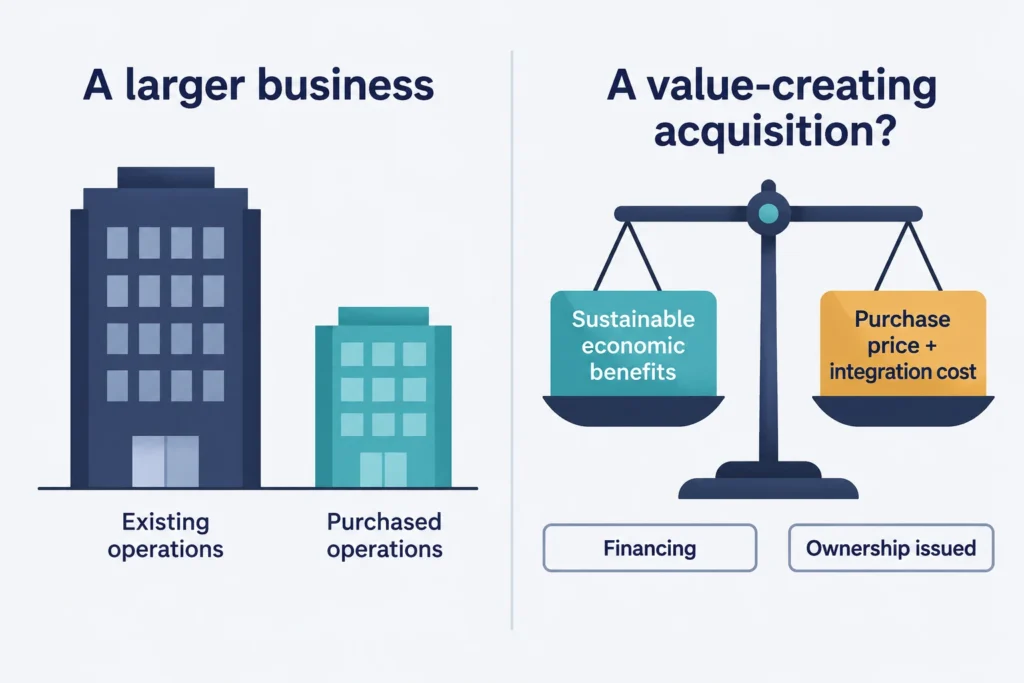
What would concern me is a company where the core business deteriorates, and an acquisition is the only way to counteract the effect.
You can test that by looking at what the integrated and reinvested business earns. Sometimes, the best you can say is “the core business is likely to improve; the deal’s return is unlikely to be proved.” You need not always have the answer.
Subtract what you can actually identify
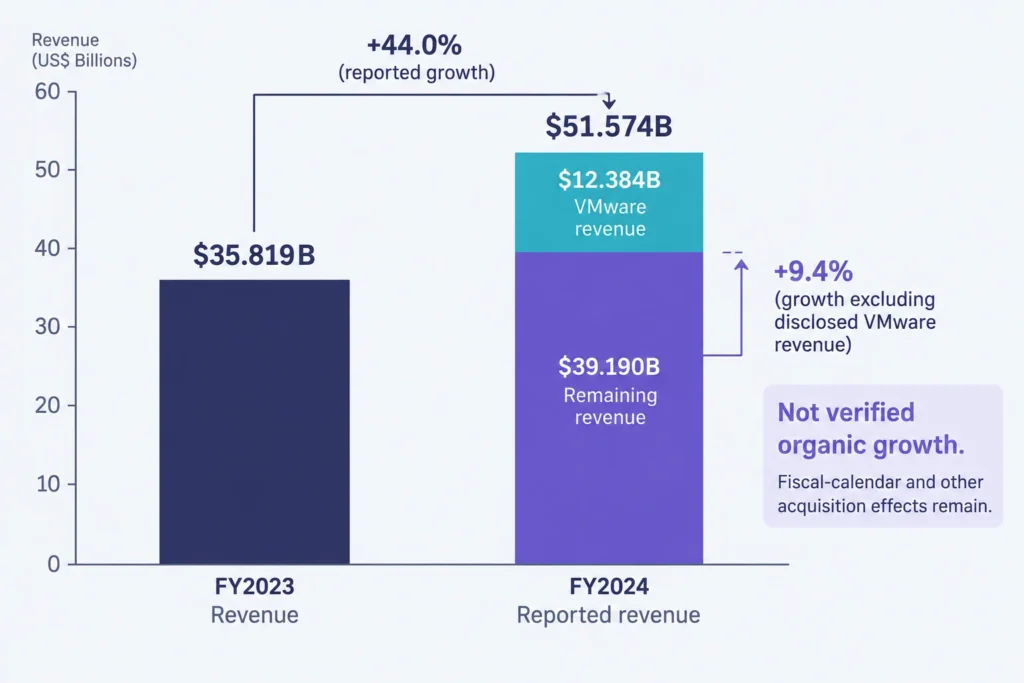
Broadcom’s fiscal 2024 report provides an example. Revenue increased to $51.574 billion from $35.819 billion. The company disclosed that $12.384 billion of the revenue was from VMware. Take VMware’s revenue out, and the picture changes.[1]
| Measure | Calculation | Result |
|---|---|---|
| Reported revenue growth | ($51.574B ÷ $35.819B), 1 | 44.0% |
| FY2024 revenue excluding disclosed VMware revenue | $51.574B, $12.384B | $39.190B |
| Growth of that residual versus FY2023 | ($39.190B ÷ $35.819B), 1 | 9.4% |
The 9.4% figure tells you that growth wasn’t entirely VMware. It does not isolate organic growth: fiscal-year lengths differ, and other acquisition effects remain. Currency and divestitures also need adjustment when relevant and disclosed. I wouldn’t fill those gaps with guesses just to produce a cleaner label.[1][2]
Imagine me during an imagined filing-reading session, with three tabs open, and a spreadsheet cell labeled “organic growth.” I subtract the acquired revenue, and have a neat answer. Then I notice the fiscal calendar mismatch. Annoying, but useful. I change the label to “growth excluding disclosed VMware revenue,” and then that shortcut becomes an investment thesis.
There's another catch when a deal closes halfway through a year: the next year gets twelve months of acquired revenue against only six. Once the acquisition anniversary passes, the acquired revenue goes away, but the old business doesn't necessarily go back to where it was. Same-footprint segment sales, customer retention, pricing, and margins give you a better picture of the business’s health. Pro forma comparisons can help with ownership period mismatches, but their assumptions carry a lot of weight. They essentially attempt to rebuild the combined business, and report what would have happened, had both businesses always been combined.[1][2]
Accounting noise isn’t the same as economic cost
Purchase accounting can also make two otherwise similar businesses look very different. Under public company US GAAP, the purchase price is allocated to the acquired assets and liabilities, and the excess is recorded as goodwill. If goodwill is determined to be impaired, the amount of goodwill is written down. A company that acquired its technology carries charges that may not exist for a company that developed the same technology. Purchase accounting may therefore lead to asymmetric accounting charges.[2]
I’m comfortable looking at earnings before acquired-intangible amortization charges, as these charges are not cash charges. However, adding back these charges doesn't make the acquired technology lasts forever. Maintenance and enhancement of the technology as well as customer replacement will continue to consume resources. Goodwill is neither an indication of failure nor of success. Avoiding an impairment of goodwill does not demonstrate the acquisition was worth the price paid.[2][8]
Integration expenses deserve less forgiving treatment. Cash integration expenses are paid by shareholders. For a serial acquirer, a string of “one-time” integration expenses can become a continual cost of a business strategy. The SEC advises that the exclusion of normal cash-operating expenses can result in a misleading non-GAAP performance measure, and thus requires a critical look at the reconciliations, as opposed to accusing an issuer of wrongdoing.[4]
One technical trap is worth retiring: don’t automatically blame post-deal revenue changes on a deferred-revenue “haircut.” For covered US GAAP combinations, ASU 2021-08 requires acquired customer-contract assets and liabilities to be measured under Topic 606. Older explanations based on fair-value write-downs may no longer apply. This isn’t an IFRS rule; foreign private issuers may file Form 20-F rather than Form 10-K, so check the stated accounting basis.[5][7]
Find the price shareholders really committed
I wouldn't lock in the announcement price. In the case of the Broadcom/VMware transaction, the acquisition consideration included a significant stock component, and the transaction also included VMware’s assumption of debt. The announcement equity value, closing accounting consideration, and enterprise cost are not the same, especially if the buyer’s share price moves before closing. The first step is to decide what price you want to start from, or the additions that follow can count the same thing more than once.[2][6]
To get to an enterprise cost view, you can start with cash and the consideration paid in shares (if any), add assumed debt, and subtract acquired cash (if any). Shares are not consideration. Costs associated with the purchase of a business that have been capitalized should also be included in the bridge, but previously recognized consideration should be excluded. Transaction costs associated with the acquisition, integration costs, and retention costs incurred in connection with the acquisition should be excluded from consideration, but should be considered in determining the total commitment of shareholders’ funds.[2][7]
The funding used to pay the purchase price of the business is also different. New debt should also be included, as the cost of new debt would also be considered in the funding assessment. Equity doesn’t require a stream of future payments like debt, but dilutes equity value among a greater number of owners. Thus, I would also include a similar-period diluted EPS in the bridge to show the total equity value.[2][8]
Earnouts can span accounting categories. Wix’s FY2025 Base44 footnote distinguishes liability-classified contingent consideration, subject to recurring fair-value remeasurement, from consideration that is contingent on founders’ continued employment and is treated as compensation. The lesson isn’t the final Base44 price. The point is that an acquisition-related commitment can be outside of reported acquisition consideration and cost shareholders’ money.[7]
Bring the announcement back to the results
Save management’s original rationale and timetable. Broadcom announced a target of approximately $8.5 billion in VMware EBITDA contribution within three years after closing. With the November 22, 2023 close, that horizon ends November 22, 2026, still ahead of the October 5, 2026 research cutoff. It’s a management target, not demonstrated achievement, and total EBITDA contribution isn’t the same as incremental synergy.[2][6]
The next metric must match the promise. Broadcom’s August 2026 quarterly filing excludes amortization, stock-based compensation, restructuring, and acquisition-related costs from its segment evaluation. Broadcom’s standalone VMware software segment is not a part of Broadcom’s blended software segment, and Broadcom’s segment operating income is not VMware EBITDA. Positive segment results may indicate progress toward the target, but not necessarily the deal’s return.[3]
The research report assumes positive impacts from cross-selling and cost savings. Both would demonstrate a declining expense line. Customer retention and revenue expansion contribute to the larger sales pipeline, but are still forward-looking. Better operating cash flow, along with positive working capital and reinvestment, demonstrate cost-savings. However, cost reductions can come at the expense of customer attrition.[8]
A positive cash effect doesn't necessarily mean a purchase was a good use of capital. In fact, cash payments are part of the investing section of the statement and don't detract from the purchase price. The SEC also warns the cash flow definition used by management may not reflect free cash flow available to the firm. Also, attribution is a concern. Broadcom states that since there would be immediate integration of VMware, it would be impracticable to determine standalone net income.[1][2][4]
A profitable addition can still cost too much
Without using Broadcom's valuation multiple, let's assume a hypothetical business costs $1 billion with an additional $50 million of immediate integration costs. The business has a sustainable after-tax operating profit of $100 million, with $20 million of depreciation. Assuming $25 million of capital expenditures and $5 million of working capital expenditures, annual cash flows would be $90 million.
Assuming no growth, cash flow continuing indefinitely, and a 10% required return, its value is $90 million ÷ 10%, or $900 million. That falls short of the $1.05 billion commitment. Break-even annual cash flow would be $105 million. At an 8% required return, the same $90 million is worth $1.125 billion; at 12%, $750 million. The assumption changes the verdict. Ten percent isn’t a universal hurdle.[8]
That's why EPS accretion alone doesn't persuade me: a deal can add earnings while earning too little for its price and risk. Match unlevered cash flows to an enterprise-value discount rate, or cash flows after financing to an equity discount rate. Mixing them can charge for financing twice. If the deal-level results disappear into the combined business, I'd leave the verdict where the evidence leaves it: improving combined economics, perhaps, but an acquisition return you still can't demonstrate.[1][8]
Sources and references
- Broadcom Inc.; SEC EDGAR: Broadcom FY2024 Form 10-K (2024-12-20)
- Broadcom Inc.; SEC EDGAR: Broadcom FY2025 Form 10-K (2025-12-18)
- Broadcom Inc.; SEC EDGAR: Broadcom Form 10-Q for the quarter ended August 2, 2026 (2026-09-10)
- US Securities and Exchange Commission: Non-GAAP Financial Measures interpretations (2022-12-13)
- Financial Accounting Standards Board: ASU 2021-08, Accounting for Contract Assets and Contract Liabilities from Contracts with Customers (2021-10)
- Broadcom Inc.: Broadcom's VMware acquisition announcement (2022-05-26)
- Wix.com Ltd.; SEC EDGAR: Wix FY2025 acquisition footnote (2026-03-05)
- Aswath Damodaran, NYU Stern School of Business: The Value of Synergy (2005-10)
