
Longer useful lives mean lower annual depreciation and higher near-term earnings. It doesn’t alter the timing of equipment payments or the eventual need to replace the equipment. I would initially give credit for the improvement to accounting. I would give the credit for improvement to operating economics only if there were evidence that the hardware was capable of doing the work profitably for a longer period.[4]
Picture me, in an imagined example, comparing two cloud stocks with a spreadsheet squeezed beside their annual reports. I notice one looks cheaper with respect to earnings. Then I see a footnote with depreciation and my orderly ranking gets spoiled. I get a little annoyed with extra work, but I’m holding off on a buy and adding an even shorter scenario based on the hardware’s economic life.
A footnote worth $0.40 per share
Microsoft provides a concrete historical example. Following a July 2022 assessment, it increased estimated server and network equipment lives from four to six years, effective in fiscal 2023. For assets held at June 30, 2022, Microsoft disclosed a $3.7 billion increase in fiscal 2023 operating income, a $3.0 billion increase in net income, and a $0.40 increase in basic and diluted earnings per share.[1]
Against reported operating income of $88.523 billion, that disclosed benefit was about 4.2%. Subtracting it gives $84.823 billion; subtracting $0.40 from reported diluted EPS of $9.68 gives $9.28. Those are my historical sensitivities, not company-restated GAAP results or a complete reconstruction of the old policy. The disclosed effect covers the opening asset base, not every new addition.[1]
Microsoft credited the extension to enhanced software-related operating efficiencies and other technology innovations. Management will present an argument; it doesn’t necessarily prove each server’s economic life. However, equipment that increases productivity and useful life should lower the number of replacements.[1]
The old servers don’t get a fresh start
Under ASC 250, a genuine estimate change affects the current and relevant future periods; prior statements aren’t rewritten. For existing equipment, the remaining depreciable amount is attributed to the revised remaining life. This is different from correcting an accounting error and is different from assuming an older server was newly acquired.[4]
Take a hypothetical $60 million server batch, depreciated straight-line over four years with zero residual value. After two full years, depreciation totals $30 million and book value is $30 million. If estimated total life becomes six years, four years remain: future annual depreciation becomes $30 million ÷ 4 = $7.5 million, rather than $15 million. The past $30 million stays recorded.
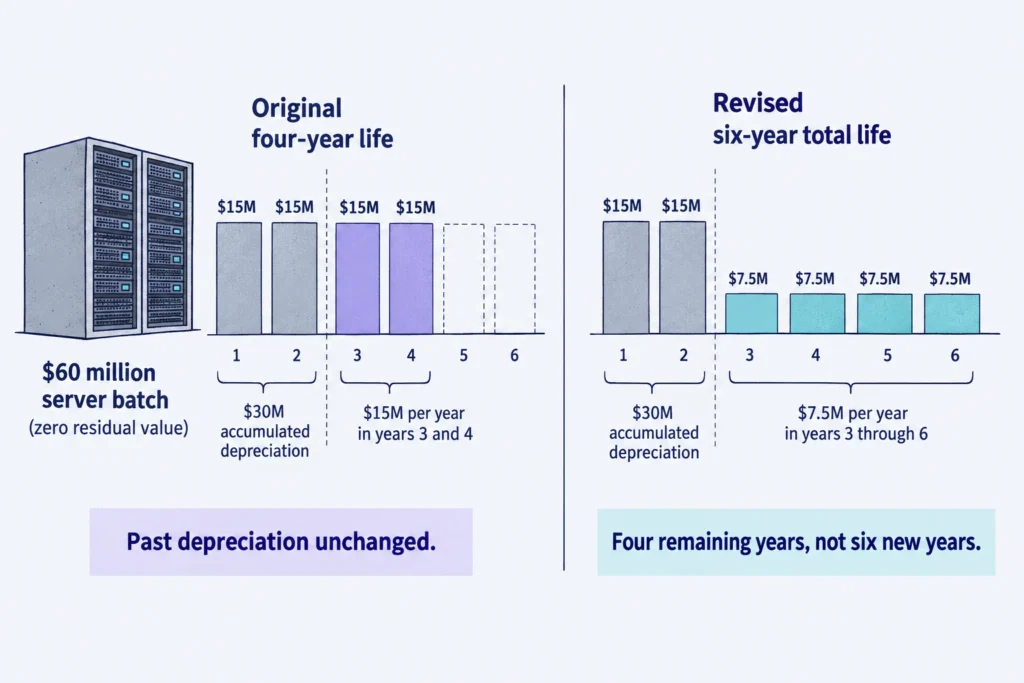
A newly placed-in-service $60 million batch assigned a six-year life would instead generate $10 million of annual depreciation under those same assumptions. Different ages, different calculations. That’s why I wouldn’t simply carry Microsoft’s $3.7 billion benefit into every future year: additions, retirements, and the aging fleet change the expense path.
The earnings-and-cash bridge needs a tax line
Book depreciation and tax depreciation are not the same thing. Tax deductions are taken according to the rules and conventions applicable to them, and may not always coincide with management’s financial-reporting estimate. Assume for this bridge that book depreciation is $10 million, that the tax rate is 20% and that tax depreciation, cash taxes and all other items are unchanged.[5]
| Item | Change | What happens |
|---|---|---|
| Book depreciation expense | , $10 | Less expense reaches operating income. |
| Operating and pretax income | +$10 | No change in revenue or other operating costs. |
| Income-tax expense | +$2 | Deferred tax expense rises; cash taxes are held fixed. |
| Net income | +$8 | The after-tax earnings benefit. |
| Depreciation add-back in operating cash flow | , $10 | There is less noncash expense to add back. |
| Deferred-tax adjustment in operating cash flow | +$2 | Reverses the additional noncash tax expense. |
| Operating cash flow | $0 | +$8, $10 + $2 = $0. |
| Equipment cash purchases | $0 | The estimate change itself changes no payment. |
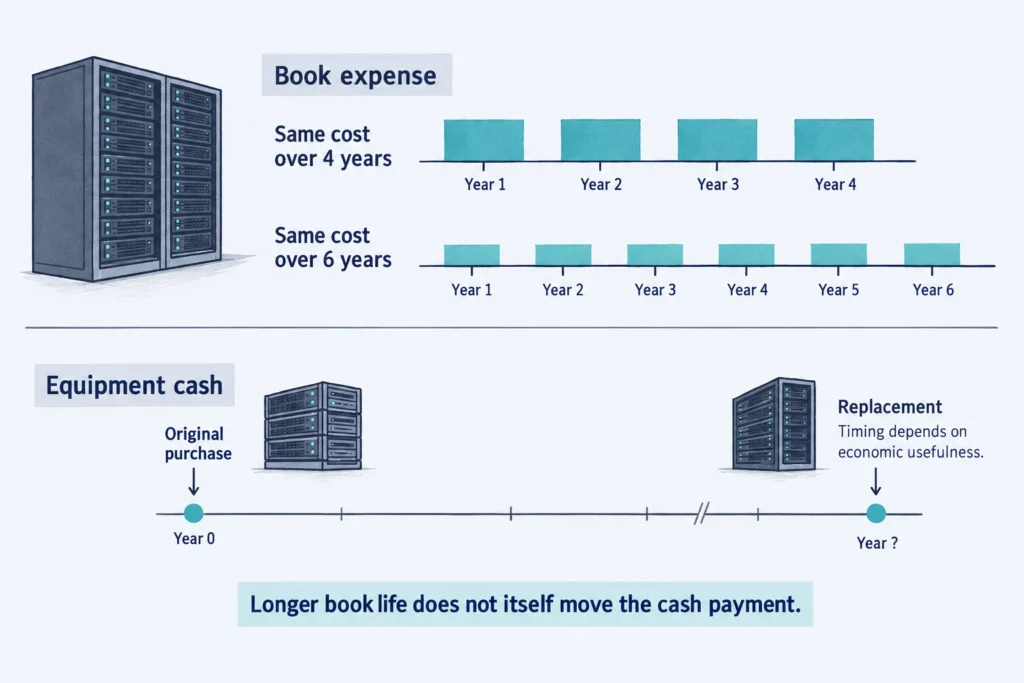
In this example the reconciliation shows an increase in earnings with no difference in cash flows. It is important to understand the mechanics of this to appreciate why a simple statement like ‘the depreciation add-back cancels the profit increase’ is not correct. Actual cross-border tax effects require a number of assumptions and this 20% example is not a forecast of company results. Adjusting useful lives of assets does not redefine financial obligations.
Six years for what, exactly?
Microsoft’s fiscal 2026 report lists server and network equipment lives of two to six years. Alphabet’s 2025 report generally uses six years for servers and network equipment. These disclosures do not suggest an AI accelerator replacement cycle of 6 years. Again, these are broad accounting categories and do not reflect actual weighted average fleet replacement.[2][6]
The direction can reverse, too. Amazon shortened a subset of server and networking equipment lives from six to five years effective January 1, 2025. Including opening assets and acquisitions, the actual 2025 effect was $1.4 billion more depreciation and amortization, $1.0 billion less net income, and $0.10 less diluted EPS, primarily affecting AWS. Amazon attributed this to faster technological development, particularly AI and machine learning, not to every asset suddenly having the same replacement date.[3]
I’d evaluate equipment, fleet ages, workloads and in-service timings before considering headline lives. Buildings and networking equipment don’t typically go hand-in-hand with compute equipment; the former doesn’t necessarily get replaced with the latter. Alphabet’s June 2026 filing states that depreciation starts when the asset is ready for its intended use, and the purchase-to-service timing can vary from a few months to multiple years. Therefore, expenses can increase even before the depreciation starts, and this will not result in an adjustment to the expected life.[6][7]
Move the replacement payment, not just the expense
To perform a cash flow valuation, estimate the time when you will have to replace capacity. Maintain a constant level of operating cash earnings and replacement cost, assume no disposal proceeds, and move one $60 million payment from the end of year six to the end of year four. At a 10% discount rate, its present-value cost rises from $60 million ÷ 1.10⁶ = $33.87 million to $60 million ÷ 1.10⁴ = $40.98 million, a $7.11 million increase.
This adjustment only addresses one payment; other payments require adjustment to represent the value of the company. Other considerations could include capacity to grow, cash taxes, and terminal value of the business. Residual proceeds of equipment sales also need to be addressed; an accelerator may still be of use for another workload, but "still runs" does not answer the question of equipment resale value. Public disclosures do not address these matters.
Don’t charge for the same hardware twice. In your cash-flow model, if you start from earnings after depreciation, you need to add back the expense of depreciation, and subtract the equipment’s cost. If you start from the revenue, you subtract the equipment cost, and don’t take another depreciation deduction. Amazon consistently shows cash purchases, and financed equipment. Cash capital expenditures and financing payments are shown separately, as well as financing leases.[8]
What would change my mind is seeing economic productivity of older equipment. This includes the equipment being redeployed for useful work, and/or limited equipement being retired and replaced prematurely. Until then, I would assume replacement is not needed, and test a shorter economic life and lower disposal proceeds in a valuation.
If a stock only looks attractive with the assumption that a double depreciation schedule is a promise about replacement, then that assumption is doing too much.
Sources and references
- Microsoft: Microsoft FY2023 Annual Report
- Microsoft: Microsoft FY2026 Form 10-K (2026-07-29)
- Amazon: Amazon 2025 Form 10-K (2026-02-06)
- KPMG: Handbook: Accounting changes and error corrections
- Internal Revenue Service: Publication 946 (2025), How To Depreciate Property
- Alphabet: Alphabet 2025 Form 10-K (2026-02-04)
- Alphabet: Alphabet Form 10-Q for June 30, 2026
- Amazon: Amazon Form 10-Q for June 30, 2026
