
Robotics investing is often described as a bet on futuristic machines. A more grounded way to look at it is this: capital tends to flow first into industries with expensive labor bottlenecks, rising quality requirements, safety pressure, and clear returns on throughput.
The latest global data supports that view. In World Robotics 2025 data covering 2024, industrial robot installations stayed above 500,000 units for a fourth straight year, while professional service robots sold more than 199,000 units and medical robots about 16,700 units. That points to a market driven by both factory automation and task-specific service automation. (ifr.org)
Why automation demand is broadening now
Three structural forces matter most right now. First, labor supply is not getting easier: the U.S. Bureau of Labor Statistics projects the labor force participation rate to fall from 62.6% in 2023 to 61.2% in 2033 as population growth slows and older age groups make up more of the workforce mix. Second, online retail is still reshaping fulfillment. The Census Bureau said e-commerce accounted for 16.9% of total U.S. retail sales in the first quarter of 2026. Third, semiconductor capacity is increasingly being treated as strategic infrastructure. NIST says the United States is on track to have eight new leading-edge logic fabs by 2030 and at least 20% of global leading-edge logic production. (bls.gov)
That does not mean every automation market moves in a straight line. Automotive is still a major customer, but it is no longer the whole story. In North America, A3’s first-quarter 2026 data showed total robot units were essentially flat because automotive OEM orders fell 35.1% year over year, even as life sciences, semiconductors and electronics, food and consumer goods, and collaborative robots posted strong gains. Full-year 2025 data also showed non-automotive demand outpacing automotive demand by units ordered. For investors, that shift matters because it changes which end markets deserve the highest conviction. (automate.org)
Use the Demand-Friction-Value screen
A practical way to judge robotics subsectors is to run them through a simple Demand-Friction-Value screen. It is an editorial tool, not an industry standard, but it helps separate exciting demos from investable markets.
- Demand: Is automation solving a structural problem such as labor scarcity, precision requirements, contamination control, or rising throughput needs? Structural demand tends to endure longer than a single capital-spending cycle. (bls.gov)
- Friction: How hard is deployment? Warehousing robots can often scale faster than surgical platforms because hospitals face training, clinical workflow, and regulatory hurdles. The FDA notes that robotically assisted surgery can be safe and effective for certain procedures when used appropriately and with proper training. (fda.gov)
- Value: Who keeps the economics? IFR notes that the service-robot market includes many small suppliers, a rising software layer, and growing robot-as-a-service models. A rising adoption curve does not automatically mean the hardware vendor earns the best return. (ifr.org)
| Industry | Why demand is rising | Main adoption friction | Where value may accrue | Signals worth watching |
|---|---|---|---|---|
| Semiconductors and electronics | Strategic fab buildout, AI-related chip demand, precision manufacturing, cleanroom automation | Large capex cycles and policy sensitivity | Semicap equipment, motion control, vision, inspection, packaging, factory software | NIST fab milestones; A3 semi and electronics order growth; whether electronics keeps leading global robot demand |
| Warehousing and logistics | E-commerce volume, labor pressure, facility throughput, repeatable mobile-robot use cases | Pricing pressure, integration complexity, customer concentration | AMRs, fleet software, sensing, fulfillment orchestration, service | Census e-commerce share; IFR logistics robot sales; utilization and recurring software mix |
| Healthcare and life sciences | Aging-driven demand, lab automation, hospital workflow efficiency, clinical precision | Regulation, training, reimbursement, long sales cycles | Medical platforms, recurring instruments and service, lab automation | IFR medical robot growth; A3 life sciences orders; FDA clearances and adoption pace |
| Food and consumer goods | Packaging labor, quality control, hygiene, traceability, fast-changing SKUs | Fragmented plants, tighter budgets, customization needs | Cobots, end-of-line automation, vision, hygienic handling | A3 food and consumer goods orders; U.S. food and beverage installation trends |
| Agriculture | High labor-cost share in labor-intensive crops and persistent labor scarcity | Unstructured environments, seasonal use, crop-specific economics | Specialty field robots, dairy automation, selective spraying and harvesting | USDA labor indicators; H-2A demand; IFR agriculture robot sales stability |
On that screen, three areas stand out most today: semiconductors and electronics, logistics, and healthcare and life sciences. Food and consumer goods looks like a credible broadening theme. Agriculture looks promising, but more uneven and longer duration. (automate.org)
Semiconductors and electronics have the clearest factory-automation runway
If the goal is to find the clearest industrial automation demand story, semiconductors and electronics is hard to ignore. NIST says the U.S. is on track for eight new leading-edge logic fabs by 2030, and global robotics data shows electronics regained the leading position in 2024 while automotive demand fell 7%. In North America, A3 reported that semiconductor, electronics, and photonics orders rose 31.7% by units and 79.2% by revenue in the first quarter of 2026. That is a powerful combination of policy support, strategic necessity, and real equipment demand. (nist.gov)
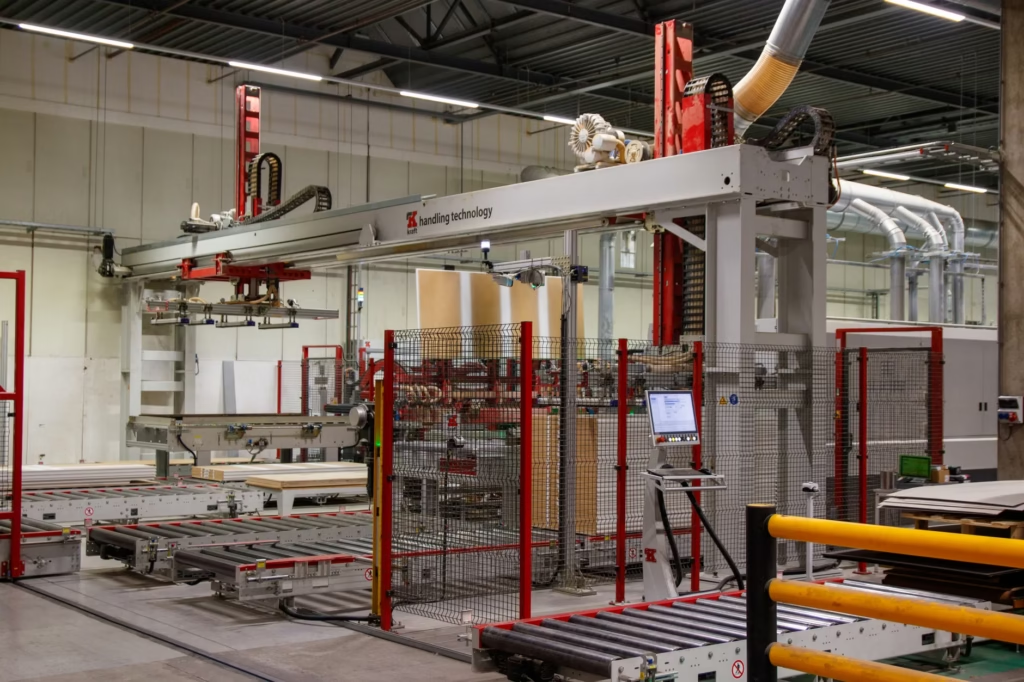
This lane matters for investors because the value chain is broader than branded robots. Wafer handling, inspection, packaging, contamination control, machine vision, servo systems, and factory software can all benefit. In many cases, the better investment exposure is the supplier that becomes embedded across multiple fabs or tool sets, not the most visible robot maker. The main risk is cyclicality: semiconductor spending can pause abruptly, and policy support does not eliminate timing risk. (nist.gov)
Warehousing and logistics is still one of the strongest service-robot markets
Logistics remains the most commercially proven service-robot category. IFR says 102,900 transportation and logistics robots were sold in 2024, meaning more than half of all professional service robots sold that year were built for moving goods. That aligns with broader retail behavior. The Census Bureau reported first-quarter 2026 U.S. e-commerce sales of $326.7 billion, up 9.8% from a year earlier, and BLS expects transportation and warehousing employment to grow as online purchases keep shifting shipping toward direct-to-consumer networks. (ifr.org)
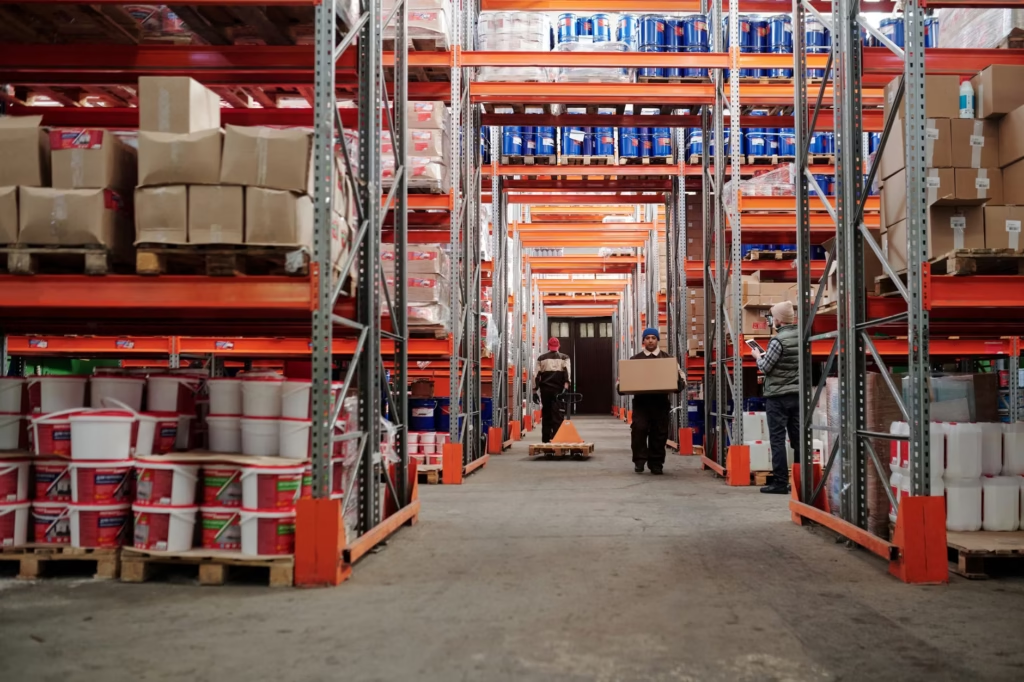
The attraction here is repeatability. Autonomous mobile robots, picking support, and goods movement can often be rolled out across multiple facilities faster than highly customized manufacturing cells. But this is also where investors can overpay for growth. Hardware can become crowded, pricing can compress, and large customers can hold bargaining power. IFR’s data also shows robot-as-a-service fleets growing quickly, which lowers customer friction but can push financing and utilization risk back onto the vendor. Better economics often come from software orchestration, fleet management, and aftermarket service rather than commodity hardware alone. (ifr.org)
Healthcare and life sciences offers higher friction but potentially stronger moats
Healthcare is not the fastest market to penetrate, but it may be one of the most durable. IFR reported medical robot sales jumped 91% to about 16,700 units in 2024, with strong growth in rehabilitation, surgery, and diagnostics and lab analysis. BLS projects healthcare and social assistance to be the fastest-growing industry sector from 2023 to 2033 because of aging and chronic-condition demand, and A3’s first-quarter 2026 data showed life sciences, pharma, and biomed robot orders up 54.1% by units and 70.2% by revenue. (ifr.org)

The reason this sector can be attractive for investors is that friction can become a moat. Regulation, validation, training, and workflow integration slow adoption, but they can also strengthen switching costs once a system is embedded. The FDA says robotically assisted surgical systems can be safe and effective for certain procedures when used appropriately and with proper training, which underscores both the opportunity and the discipline required. Investors should look beyond headline surgical systems as well. Lab automation, hospital logistics, pharmacy automation, and rehabilitation can offer less flashy but more diversified exposure. (fda.gov)
The quieter growth markets deserve more attention
Food and consumer goods is a good example of an underappreciated automation buyer. A3 said it was North America’s fastest-growing robotics sector in 2024, with orders up 65%, and the same category rose another 16% in units in the first quarter of 2026. IFR’s U.S. data also showed food and beverage installations up 21% to 2,200 units in 2024. This is not the market that gets the most social-media excitement, but packaging, palletizing, inspection, and hygienic handling are real spend categories with repeat demand. (automate.org)
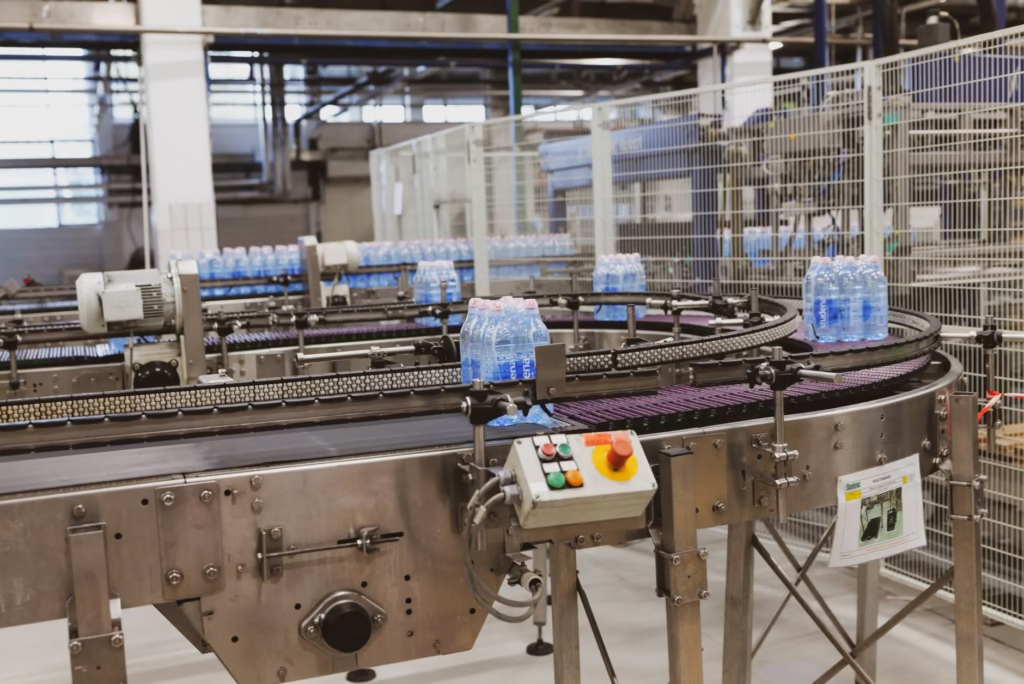
Agriculture deserves a different label: important, but earlier and less even. USDA says labor-intensive farms carry far higher labor-cost shares than the farm average, and the number of H-2A positions certified in fiscal 2024 reached around 385,000 after rising more than sevenfold over 19 years. IFR’s 2024 service-robot data put agriculture among the top professional service-robot categories, with close to 19,500 units sold, but sales slipped 6% from the prior year. That is a useful reminder that the need is real while the adoption curve remains uneven. (ers.usda.gov)
Where investors often get robotics wrong
- They chase attention instead of order flow. The current demand data is strongest in semiconductors and electronics, logistics, healthcare and life sciences, and selected general-industry markets, not just in the most viral robot categories. (automate.org)
- They treat automotive as the whole market. Automotive still matters, but A3’s latest data shows that one cyclical swing in OEM orders can mask stronger broad-based demand elsewhere. (automate.org)
- They assume adoption equals profit. IFR notes that 80% of service-robot companies are small or medium-sized enterprises and that software is gaining importance, while many firms act more like integrators than defensible platform owners. (ifr.org)
- They see robot-as-a-service as pure upside. RaaS can accelerate adoption, but it can also shift balance-sheet burden and utilization risk to the provider. (ifr.org)
How to build a robotics watchlist without chasing hype
- Separate the universe into buckets: robot OEMs, enabling components, software and integration, and end-market adopters. Those buckets behave very differently in downturns and upcycles.
- Rank each target with the Demand-Friction-Value screen. A sector with explosive demand but weak value capture may still be a poor investment lane.
- Check how much revenue is recurring. Service, software, consumables, and maintenance often deserve more weight than one-time project revenue.
- Watch leading indicators by sector: A3 order mix, IFR industrial and service-robot data, CHIPS buildout milestones, Census e-commerce share, BLS labor and healthcare projections, and USDA labor signals. (automate.org)
- Stress-test the balance sheet. Fast unit growth can still disappoint if working capital expands, customer concentration rises, or RaaS financing outruns cash generation. (ifr.org)
- Re-underwrite the thesis when policy or customer mix changes. IFR’s U.S. outlook notes that trade tensions and policy uncertainty can weigh on the robotics market in the short run even when long-term automation demand remains favorable. (ifr.org)
A hypothetical example makes the tradeoff clearer. Suppose an investor is choosing between a warehouse-robot maker, a motion-control supplier that sells into several automation markets, and a medical-robot platform with recurring instruments revenue. The first may offer faster top-line growth but fiercer pricing pressure. The second may have lower headline excitement but better diversification. The third may have slower sales cycles but stronger switching costs. The point is not that one bucket always wins. It is that the most impressive robot demo and the strongest investment setup are often different things.
Humanoid robots may become commercially important over time, but today’s broad order-flow data still points more clearly toward semiconductors and electronics, logistics, healthcare and life sciences, and selected general-industry applications. Investors should follow deployable economics before following spectacle. (automate.org)
What would change the thesis
The bullish case weakens if semiconductor buildouts are delayed, e-commerce growth cools enough to reduce warehouse spending, hospitals and life-science buyers pull back on capital budgets, or RaaS expansion arrives with poor unit economics. It also weakens if general-industry growth stalls and the market falls back into narrow automotive dependence. Recent A3 data shows how easily automotive swings can distort the aggregate picture, and IFR has cautioned that trade tensions and policy uncertainty can weigh on robotics in the near term even when long-run automation demand remains positive. (automate.org)
The strongest robotics investing ideas are usually found where commercial necessity is already visible. Right now, that points most clearly to semiconductors and electronics, logistics, and healthcare and life sciences, with food and consumer goods as a meaningful secondary theme and agriculture as a longer-dated watchlist sector. The discipline is to start with the industry pain point, then identify where the economics actually sit. That is a better guide than betting on whichever robot looks most futuristic this quarter. (nist.gov)
Frequently Asked Questions
Is automotive still an important robotics market?
Yes. Automotive remains a major buyer, but it is no longer a sufficient stand-in for the whole automation market. IFR’s global 2024 data showed automotive demand down 6.9% while electronics regained the lead, and A3’s recent North American data showed broader strength outside automotive OEMs. (ifr.org)
Are collaborative robots automatically the best way to invest in automation?
Not necessarily. A3’s 2025 data showed cobots rising to 19.6% of total robot units ordered in North America, and first-quarter 2026 data showed especially strong use in life sciences and semiconductors and electronics. That supports the product category, but the investment case still depends on margins, software attachment, channel strength, and competition. (automate.org)
Why can robotics adoption rise while some robotics stocks still disappoint?
Because adoption and value capture are different things. IFR’s service-robot data shows a fragmented supplier base, a growing software layer, and expanding robot-as-a-service models. In practice, profits may flow to components, software, service, or integrators rather than the most visible hardware vendor. (ifr.org)
Is agriculture too early for most public-market investors?
For many investors, yes. USDA data shows strong reasons for automation, especially labor scarcity and high labor costs in labor-intensive crops, but IFR’s 2024 figures also show agriculture robot sales can be uneven from year to year. That makes it more suitable as a selective watchlist theme than a blanket conviction call. (ers.usda.gov)
What should investors monitor every quarter?
At a minimum: A3 order mix by industry, IFR updates on industrial and service-robot demand, semiconductor buildout milestones from CHIPS-related sources, Census e-commerce data, and labor or healthcare demand indicators from BLS and USDA. Those signals help distinguish a durable adoption story from a short burst of enthusiasm. (automate.org)
References
- International Federation of Robotics – World Robotics 2025 industrial robots press release – https://ifr.org/ifr-press-releases/news/global-robot-demand-in-factories-doubles-over-10-years?stream=top
- International Federation of Robotics – World Robotics 2025 service robots release – https://ifr.org/news/service-robots-see-global-growth-boom/1st-
- International Federation of Robotics – World Robotics 2025 service robots executive summary – https://ifr.org/img/worldrobotics/Executive_Summary_WR_2025_Service_Robots.pdf
- Association for Advancing Automation – Q1 2026 robot orders – https://www.automate.org/robotics/news/robot-orders-hold-steady-in-q1-2026-as-demand-broadens-across-non-automotive-industries
- Association for Advancing Automation – full-year 2025 robot orders – https://www.automate.org/robotics/news/robot-orders-grow-6-6-in-2025-as-general-industries-drive-broader-automation-adoption
- NIST – CHIPS Program Office Vision for Success: Two Years Later – https://www.nist.gov/document/chips-america-vision-success-two-year-report
- U.S. Census Bureau – Quarterly Retail E-Commerce Sales Report – https://www.census.gov/retail/eCommerce.html
- U.S. Bureau of Labor Statistics – Employment Projections 2023-2033 – https://www.bls.gov/news.release/archives/ecopro_08292024.pdf
- USDA Economic Research Service – Farm Labor – https://ers.usda.gov/topics/farm-economy/farm-labor
- FDA – Computer-Assisted Surgical Systems – https://www.fda.gov/medical-devices/surgery-devices/computer-assisted-surgical-systems
