

In the case of a tech company, a large cash balance reduces financing risk if that cash is actually used to cover required outflows as they become due, even if cash flows are not generating cash at an adequate level. I put much more weight on a cushin that gives survival through a bad year versus an impressive total on the balance sheet. Cash buys time. It can't stop a business from deteriorating or a stock from being overvalued.
Picture me, in an imagined example, opening a filing after seeing “$1 billion in cash” in a presentation. My spreadsheet has one reassuring green cell, until a footnote sends me hunting for which subsidiary holds the money and a debt schedule puts a repayment next spring. That little scavenger hunt would irritate me, but it would also change my next move: put dates beside the dollars before calling them protection.
Start with money the paying entity can use
Cash and marketable securities can have very different behaviors. Coherent’s fiscal 2026 accounting policy defines cash equivalents as highly liquid securities with a maturity of 3 months or less. Original maturity matters: a bond bought years ago does not become a cash equivalent merely because repayment is now three months away. Apple’s June 27, 2026 filing separately reports cash equivalents and current and non-current marketable securities.[1][2]
For securities, I need to know the maturity date, and whether there is an open market for the security where it can be sold at a reasonable price prior to maturity. A bond that is not currently due may be saleable. A currently due investment is not automatically saleable without a loss. An investment in a bond has several risks including interest-rate risk, credit risk and liquidity risk. The longer the maturity of the bond, the greater the interest rate risk is. When using various stress tests to consider the potential risks to the investment, consider the instrument being stressed rather than using a “one size fits all” type of stress test. If a security is reported at fair value, and there is an unrealized loss, removing the security again would result in the loss being reported twice.[2][4]
Then comes a separate question: who is allowed to spend it? Under US GAAP, the cash-flow statement’s beginning-to-ending reconciliation includes restricted cash. Coherent’s June 30, 2026 disclosure illustrates how that total can include subsidiary-restricted funds. A cash-flow total exceeding balance-sheet cash need not be an error, or extra freely available money. Reconcile the two before deducting anything, so you don’t remove restricted cash from a total that already excludes it.[1][3]
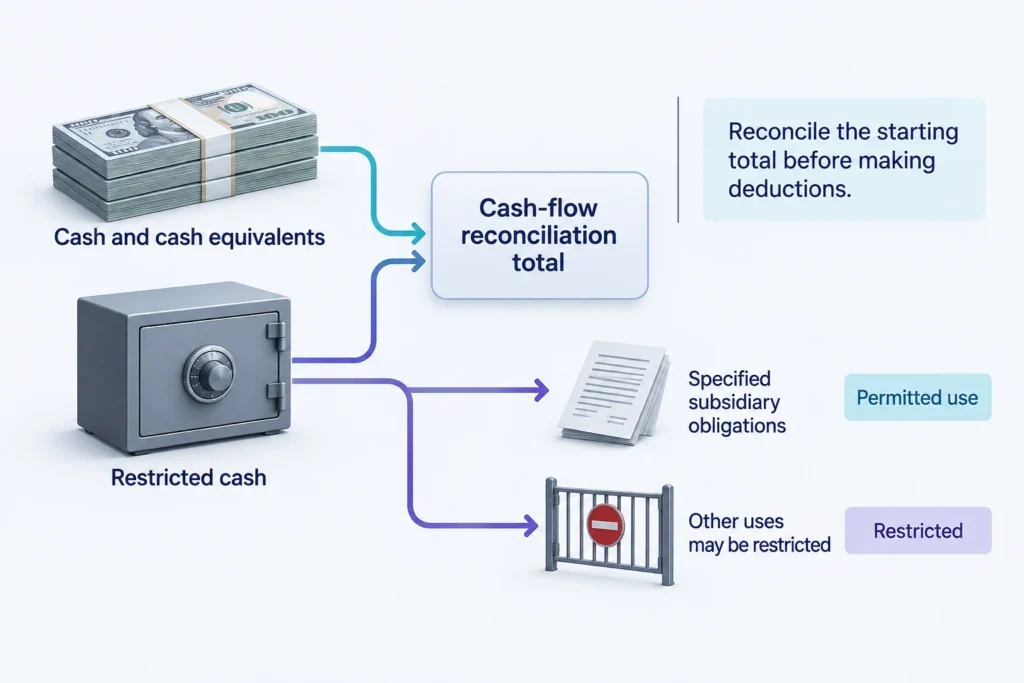
Restricted funds may still pay the permitted subsidiary’s bills. Match them to those bills rather than pretending they have no value. Likewise, foreign-held cash is not automatically unusable: transfer restrictions, taxes, local funding needs, and timing matter. Where disclosures leave access uncertain, I’d show a range instead of assuming either instant transfer or permanent exclusion.[1][3]
The repayment date can change the answer
Gross cash flow tracks out cash spent, but cash minus all debt tracks cash flow in relation to obligation timing. When would cash flow in to retire a debt? You need to correlate cash flows for interest payments and debt maturity with other cash out or cash in flows for leases, purchase commitments, capex, and test covenants. Determine when cash outflows for capex, leases, and purchase commitments occur (or are expected to occur) and align with cash flows for interest and debt maturity.
You must analyze the covenant definition, exceptions, and remedies to determine whether a ratios violation deems default. A distant maturity does not settle the default question.[4]
I wouldn’t subtract every future supplier commitment from cash. Some payables support cash inflows and can be treated as payments in advance. The payment associated with the cloud service to be received in the future does not need to be subtracted from cash. The obligation to make the payment to retire the debt is not captured in operating cash flow.
Discretionary spending is different. Apple’s June 2026 filing treats an authorized share repurchase differently from purchase obligations. Pausing buybacks maintains liquidity, but avoiding serving customers by not purchasing equipment may maintain cash at the cost of business health.[2]
The cushion can run out before the cash does
Imagine you’re valuing a hypothetical company on September 30, 2026, in USD millions. The $1,000 headline balance has $100 of cash unavailable to meet the obligations being simulated and another $100 of investments, which management has assumed to be unmonetizable within the forecast period. Thus, the available funds to the business is $800. If management wishes to maintain $200 of cash available to meet the operating requirements of the business, available headroom for investment would be $600, not the $1,000 shown in the headline.
The $200 cash reserve is an estimate of cash required to meet operational requirements, such as payroll and payments to suppliers, and to offset the effects of variation in collections. There is not a standard reserve that is applicable to all companies. In this example, baseline operating cash flows, after necessary capital expenditures, is a cash inflow of $25 per quarter. However, if collections and margins deteriorate, it could result in a $75 quarterly cash outflow. These scenarios all assume that all operating commitments, interest, and investments have already been met. The $400 principal repayment due in March is still to come.
| Quarter ending | Baseline liquidity | Stressed liquidity | Debt principal paid |
|---|---|---|---|
| December 31, 2026 | $825 | $725 | $0 |
| March 31, 2027 | $450 | $250 | $400 |
| June 30, 2027 | $475 | $175 | $0 |
| September 30, 2027 | $500 | $100 | $0 |
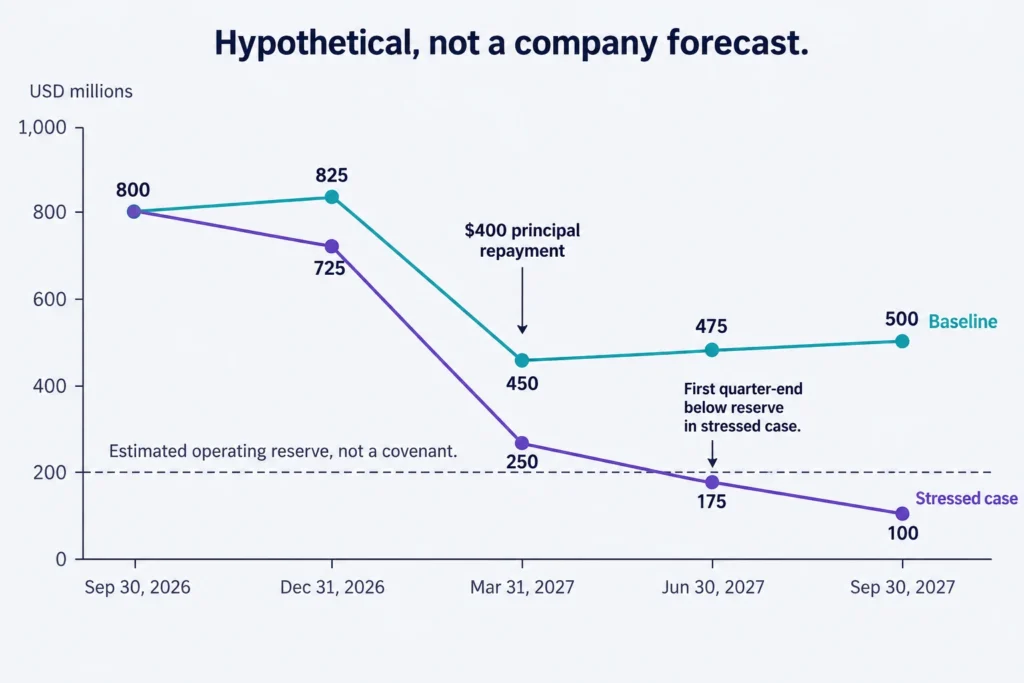
The stressed case drops below the $200 reserve in the third forecast quarter, June 2027. It started with $400 of positive net cash with $800 of usable assets and $400 of debt. Dividing $600 of reserve headroom by the $75 quarterly outflow gives an estimate of eight quarters to the reserve, ignoring the principal payment. That is the math I would want reviewed before feeling secure about net cash.
Go below this estimated reserve means less flexibility, and does not mean automatic default or insolvency. June is the first quarter-end warning in this model, however quarterly figures can not give you the first day cash gets tight. If the repayment comes before a collection surge, consider the months between, especially the payment date. An average can mask the very gap you are trying to find.
Protection for the company is not a payout promise
Keep owned liquidity and potential bailout options separate. An undrawn facility relies on borrowing terms. Refinancing depends on lenders and market conditions. Show these separately, along with potentially spending and asset realization options. Otherwise, you are forecasting someone else’s will to extend.
A solvent business shows potential long-term health, though the company may not have enough cash to pay bills in the short-term. Solvency takes into account a company’s assets and how those assets create earnings to pay obligations. This also doesn’t guarantee how much, if any, cash can be distributed after requirements and restrictions. Of the cash that can be distributed, debt service is usually the first to be paid, bondholders are usually paid before shareholders, and common dividends are paid after. I’d prefer to have the breathing room, but I don’t think it means we are required to make a payout.[4]
For this hypothetical company, the March payment leaves stressed liquidity at $250, still above the reserve, but only by $50. I’d want to see whether collections and margins can improve enough to stop the subsequent drain, or whether completed financing changes the cash schedule. Without that change, June is the first modeled quarter-end below the reserve. The useful reassurance is room to keep the business running through weaker conditions, not merely a positive cash balance.
Sources and references
- Coherent Corp.; filed with the US Securities and Exchange Commission: Coherent fiscal 2026 Form 10-K (2026-08-14)
- Apple Inc.; filed with the US Securities and Exchange Commission: Apple fiscal third-quarter 2026 Form 10-Q (2026-07-31)
- Financial Accounting Standards Board: Accounting Standards Update 2016-18, Statement of Cash Flows: Restricted Cash (2016-11)
- US Securities and Exchange Commission, Office of Investor Education and Advocacy: What Are Corporate Bonds? (2013-06-04)
