

An at-the-market stock offering elongates a company’s cash runway only if the offered shares are sold, and the proceeds are later received. The size of an announced offering is neither cash nor committed funding. Rather, a company’s existing shareholders lose some or all of their ownership as new shares are issued. For the same cash target, a lower sale price means that more shares are issued, and therefore greater ownership is lost. In the case of an offering, I’d assess it from both aspects. That is, how much time is bought for, and what is the cost of ownership lost?[1][2]
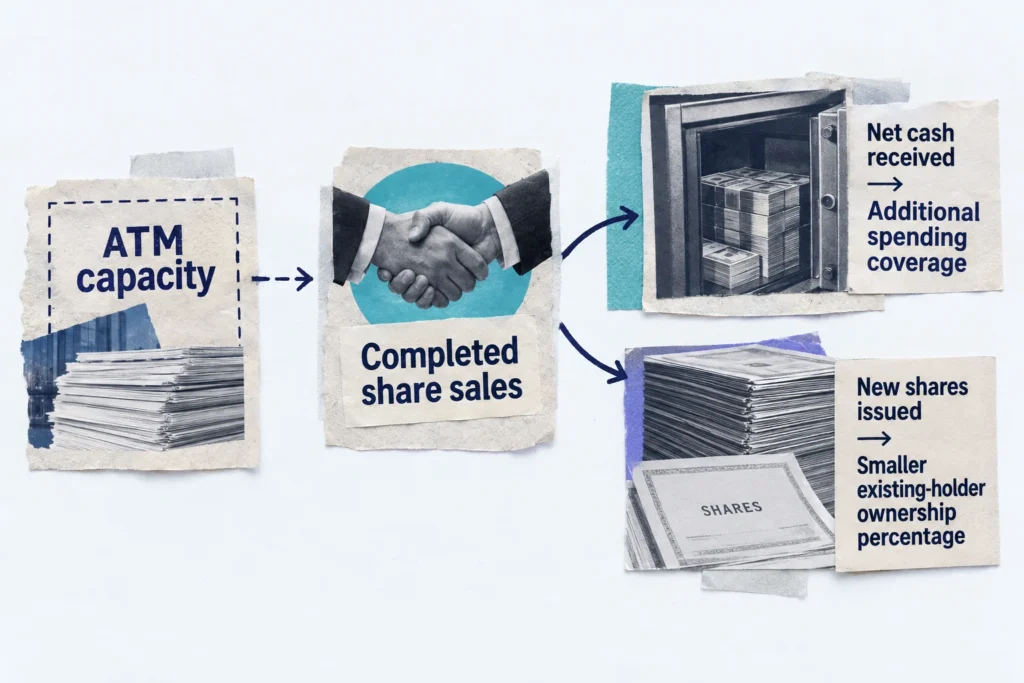
Picture me, in an imagined example, updating a spreadsheet after a financing headline. In the cash section, I’ve input the entire size of the offering, but the filing states that shares may be sold. I have to undo my calculation of the runway. This small hassle is useful. I move the authorization into a separate line and leave the cash section the same, until I have evidence of shares actually being sold.
The $350 million headline became financing, but not on announcement
Rigetti Computing’s May 2025 ATM prospectus permitted up to $350 million in gross stock sales, with agent commissions up to 3%. The shelf registration supplied the broader registered offering framework; the ATM set up a particular sales program within it. Neither put money in the bank, and the prospectus didn’t promise any sales or full utilization. That’s why I’d keep the headline amount out of your cash calculation.[1]
The Jefferies agreement made the uncertainty explicit: placement wasn’t guaranteed. Sales depended on market demand, registration, authorized shares and remaining program capacity, and Rigetti couldn’t issue sales notices while possessing material nonpublic information. The company could also specify a floor price, which couldn’t be below $1 without the agent’s consent. That last provision belonged to this agreement, not every ATM. You’re looking at flexibility to raise money, not a committed check.[2]
The June 30, 2025 Form 10-Q supplied the evidence that changed the picture: $350 million of gross sales, 30,309,780 shares issued, a reported weighted-average sale price of $11.55, and $346.7 million in proceeds after $3.3 million of commissions. Remaining capacity was zero. This program had become completed financing, rather than merely a possible source of funds.[3]
There is a small accounting wrinkle which I think is important. “After commissions” does not necessarily mean “after every offering expense”. The cash flow statement reported $798,000 of offering expenses. The disclosures do not allocate the costs to this ATM, therefore I would not subtract all the costs to determine exact program-level net proceeds.[3]
Care should be taken with the share count as well. In rounded millions, the first-half bridge was 283.547 opening shares + 30.310 ATM shares + 3.020 Quanta shares + 1.595 option shares + 0.056 warrant shares + 5.234 restricted-stock-unit releases = 323.762 closing shares. I like seeing the numbers reconcile, but the important point for you is attribution: blaming the entire increase on the ATM would fold employee equity and a separate investment into its ownership cost.[3]
The same cash can cost very different amounts of ownership
Here’s a hypothetical example, not a forecast for Rigetti, for a $50 million net funding request with 100 million shares outstanding. Assume a 3% commission, no other fees and a fully exercised warrant. The required new shares would be $50 million ÷ ((1-0.03) × average share price). Add fixed costs to the net funding amount in the numerator to account for fees.
| Average issuance price | New shares | Post-raise shares | Relative ownership dilution |
|---|---|---|---|
| $5 | 10.309 million | 110.309 million | 9.35% |
| $10 | 5.155 million | 105.155 million | 4.90% |
| $20 | 2.577 million | 102.577 million | 2.51% |
Ownership dilution uses the post-issuance denominator: new shares ÷ total shares after issuance. At $5, the share count increases 10.31%, but existing holders’ ownership falls 9.35% relative to their previous stake. Someone owning 1% before the raise would own about 0.9065% afterward, assuming they bought no new shares.
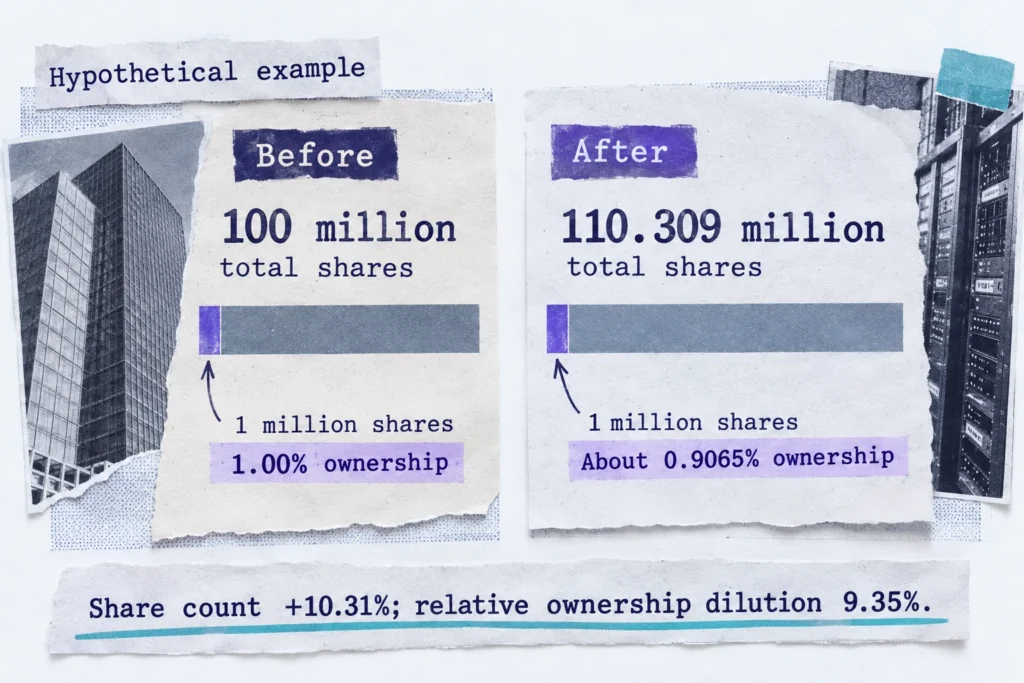
At an unchanged $10 million monthly cash requirement, each completed scenario buys five additional months. You get the same time at very different ownership costs. I wouldn’t quietly drop the word “completed,” though: a lower price requires more shares without guaranteeing enough buyer demand or legal capacity to sell them. Nor is ownership dilution an equal percentage loss of wealth, because the business receives cash in exchange. What shareholders gain depends on the issuance economics and what the company does with that money.[1][2]
Runway needs a spending budget, not just division
In terms of dollars, look to a later, more explicitly dated, financial statement. As of June 30, 2026, Rigetti reported cash of $27.763 million, short-term investments of $365.946 million, and long-term investments of $147.586 million. Combined, that’s $541.295 million. The investments were Treasury securities and, assuming they can be monetized at their fair value, that provides additional liquidity. Earlier financing is already reflected in the balance, so the 2025 ATM proceeds would essentially give the company an additional equity infusion.[5]
I am wary of a runway number given the trend in spending. The company spent $31.993 million in cash in the first half of 2026 and made capital expenditures of $16.404 million for a total of $48.397 million, about $8.07 million per month. Spending for the comparable first half of 2025 was $38.034 million or about $6.34 million per month. That’s a 27% reduction from the newer period. Adjusting for the newer rate of spending, the cash on hand gives about 67 months of runway, but that freezes cash spending for more than five years and I would use that as a reference calculation only.[5]
There are also other payments to consider. Purchase obligations for June 2026 were $35 million, with $21 million of that for property and equipment expected to be paid within a year. Rigetti had agreed to invest at least $250 million in quantum computing over five years starting in February 2025. While that doesn’t mean Rigetti has to come up with $250 million immediately, some of that may be included in the development spending Rigetti has already committed to.[4][5]
I’d include planned purchases and development payments in forward cash spending together with operating and capital spending and other commitments. If you take a commitment away from liquidity and include payments for it in monthly spending, you count it twice. Working capital fluctuations, interest receipts, and commercialization investments can also impact the result, and the historical average doesn’t answer those questions.
Let’s do a sensitivity test that you can repeat: Assume a $40 million reserve and test total forward cash requirements of $10 million or $12 million monthly, including planned payments. Coverage is ($541.295 million, $40 million) / monthly spending, which works out to approximately 50 months or 42 months. The liquidity input is reported; the reserve and spending rates are my assumptions, not the company’s guidance. Based on the information disclosures, I can’t say either budget captures the full future payment schedule. These are scenarios built using the June 30th balances, and not estimates of cash available today.[5]
What the next filing can, and can’t, settle
The lack of visibility into Rigetti’s financials makes it difficult to fairly value its stock. A later financing announcement may offer more information. In the September 8, 2026 filing, Rigetti disclosed a U.S. Government grant of up to $100 million for eligible projects, containing conditional payments, and an expected 7,739,938 share issuance. I am not putting the full $100 million into unrestricted cash, and would not consider the expected share issuance as completion. Nor do I include them in the ATM totals.[6]
In the next filing, look for the actual shares sold and realize the prices, consider the costs, and leave an allowance for future sales. Also look to see if shares are reported and explain the difference. I would like to understand what funded period would bring us to a commercially significant milestone, giving us some leeway for delays. Furthermore, I want to understand what previous/current investors are giving up to get to that milestone. The cash raised reduces the risk of going out of business, but we need other forms of evidence to reassure us customers will pay enough to cover the costs of the business.
Sources and references
- Rigetti Computing, Inc.; SEC EDGAR: Rigetti May 2025 ATM prospectus supplement (2025-05-30)
- Rigetti Computing, Inc.; SEC EDGAR: Open Market Sale Agreement with Jefferies (2025-05-30)
- Rigetti Computing, Inc.; SEC EDGAR: Rigetti Form 10-Q for June 30, 2025
- Rigetti Computing, Inc.; SEC EDGAR: Rigetti Form 10-K for December 31, 2025 (2026-03-04)
- Rigetti Computing, Inc.; SEC EDGAR: Rigetti Form 10-Q for June 30, 2026
- Rigetti Computing, Inc.; SEC EDGAR: Rigetti September 2026 government financing Form 8-K (2026-09-08)
