

Software company’s remaining performance obligations, or RPO, describe contractual work that is not yet completed, and for which company has not yet earned any portion of transaction price, but will in the future. This indicates potential future revenue. RPO does not state whether customers have made payments, whether the full balance becomes revenue next year, or whether the expected revenue is profitable. I would focus on the recognition schedule rather than backlog, to get an idea about the extent of your contractual support for your revenue growth forecast.
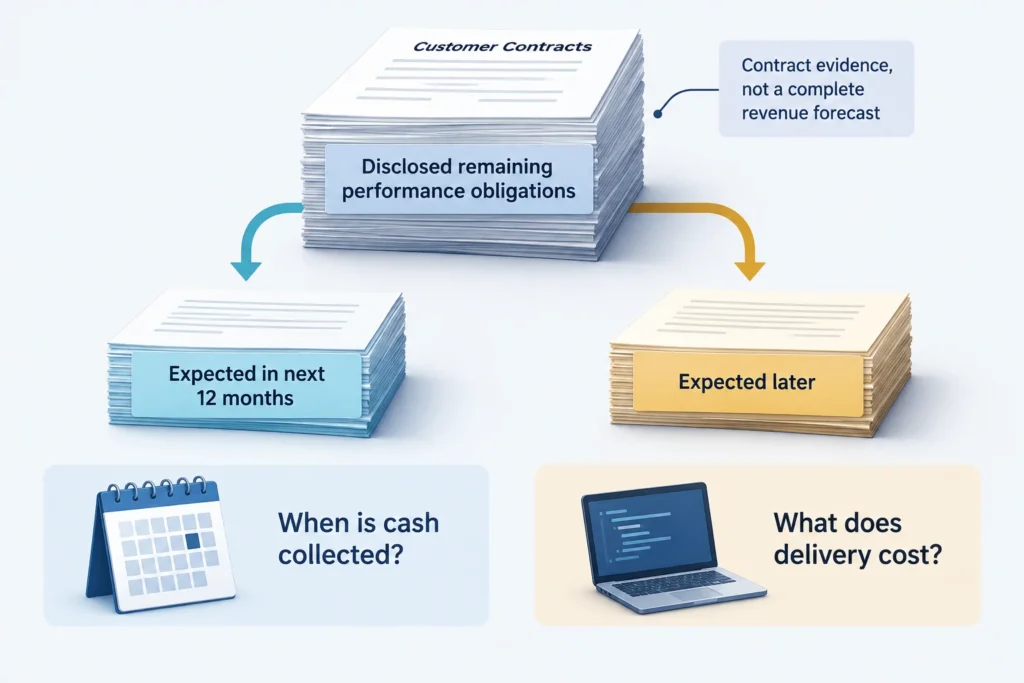
Picture me, in an imagined example, with a filing open beside a spreadsheet whose revenue cell is already shaded green. The backlog appears large enough to justify this, until I look at the recognition schedule that spans several years. That would annoy me and save me from a greater problem. I would replace the total with the expected amount during my forecast period.
One contract can produce several different numbers
(Hypothetically speaking), a noncancelable 3-year subscription costs $360, billed at $120 per year. Service is evenly provided, the first invoice is due before service starts, and there are no variable charges, financing adjustments, or refunds. Initially, RPO is $360; $120 of deferred revenue and $240 of unbilled commitments. There is also a $120 receivable, but no cash is collected yet.
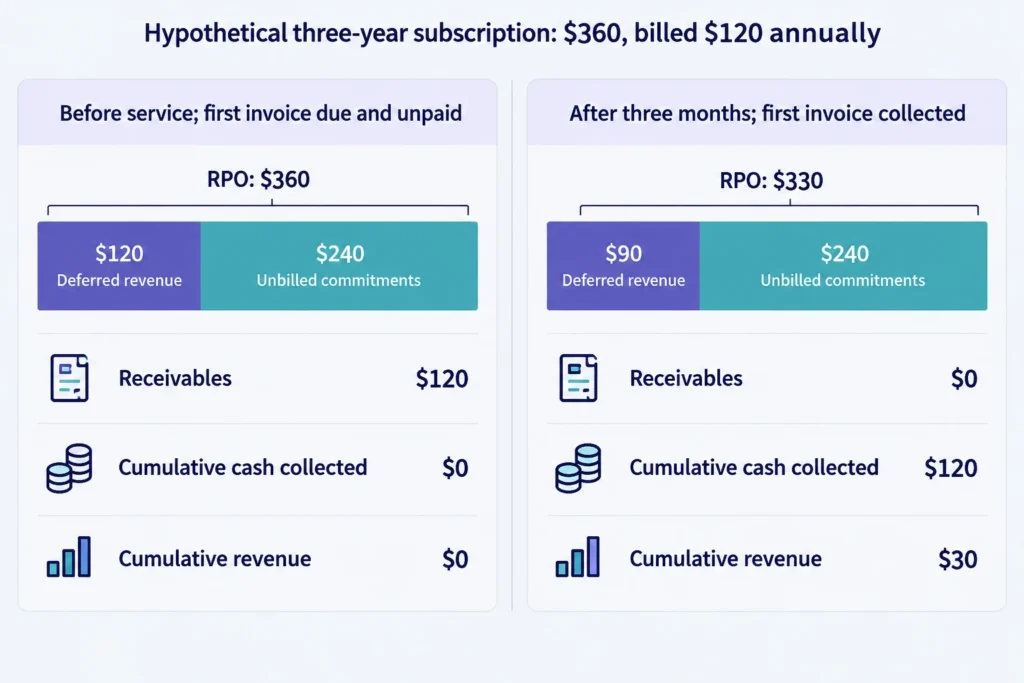
Three months of service produce $30 of revenue, leaving $330 of RPO: $90 deferred and $240 unbilled. If the customer has paid the invoice, cash collected is $120 and the receivable is zero. I find that separation useful: payment settles what the customer owes, and service delivery reduces what the company owes the customer.
In this instance, adding deferred revenue to RPO would represent double-counting. A contract liability, also known as deferred revenue, occurs when payment is made or becomes due prior to performance. It does not represent cash in the bank. Billings refer to invoicing, not collection. If a company reports a calculated billings metric or an informal “backlog,” the definition is key. Neither term, when used in a stand-alone fashion, indicates the metric is in alignment with ASC 606 RPO.[1]
The next twelve months are not the whole backlog
When considering a one-year forecast, the useful number is the amount expected to be revenue in that year. A company may disclose the timing of recognition in bands or describe it qualitatively. A term like “current RPO” requires explanation; in the context of the company using the term, it could mean the expected recognition occurs within the next 12 months, rather than reflecting the current contract liability or cash collectible in that period.[1]
A longer contract can strengthen total RPO without doing much for next year’s revenue. I welcome an extra year of customer commitment, but I wouldn’t let it stand in for faster near-term growth. Compare total RPO, next-twelve-month RPO, and recognized revenue growth over matching periods. If the headline accelerates while the near-term portion doesn’t, contract length is one explanation to investigate, alongside renewal timing, currency, and acquisitions.
Timing also depends on what earns the revenue. In an evenly delivered subscription, elapsed service time drives recognition. If the contract instead earns revenue as the customer consumes the service, your forecast needs a usage assumption. A binding commitment can be meaningful without fixing the recognition date. “Contracted” and “next year” are not synonyms.
Nor is disclosed RPO necessarily the whole future revenue pipeline. ASC 606 permits specified disclosure exemptions, including contracts with an original expected duration of one year or less, qualifying right-to-invoice arrangements, and certain variable consideration. Whether those exemptions apply, and whether the company uses them, changes what you’re comparing. A three-year contract with six months left doesn’t qualify for the short-contract exemption merely because time has passed. That’s remaining duration, not original duration.[1]
Read cancellation terms before inventing a haircut
Cancellation rights are the first thing to consider because they define the period of enforceable contract. If a customer can terminate a renewal without a penalty, what is contracted for beyond that time is not mandatory. It is a different case to say customers can terminate what has already been reported.[2]
I’d be more worried by the disclosure of a right to a refund or a modification to the contract to reduce the quantity or extend the payment terms, than worried about the vague statement “backlog can be canceled”. You have terms to evaluate in those cases. Enforceability does not address the risk of default or renegotiation. That being said, you don’t have customer specific terms, and stating that you have a 10% cancellation rate is speculation, not fact. You can stress that assumption, you can’t state it’s fact.
Give the forecast a dated starting pool
Let’s do a very hypothetical example, not company guidance. Let’s say your company has $10B of disclosed RPO, and you expect 50% conversion of that RPO in the next 12 months. Your expected revenue for that period is $7B. Your forecast needs $2B from outside that period. Your opening disclosed RPO has a $5B contribution for that time period.
| Forecast component | 50% conversion | Slower 40% conversion |
|---|---|---|
| Revenue from opening disclosed RPO | $5 billion | $4 billion |
| Revenue needed from outside that opening pool | $2 billion | $3 billion |
| Total revenue target | $7 billion | $7 billion |
The slower case shifts $1B from the forecast period without assuming the commitments disappear. The remaining revenue could come from contracts signed and partially fulfilled, renewals signed outside of the opening contract period, and/or business not included in the disclosed RPO. The $3B gap is revenue that is still required to be explained, not a goal to achieve new bookings. A large, multi year signing could fill the backlog and contribute very little to this year’s sales.
There are two easy ways to mislead yourself here. Adding current RPO to the percentage-based contribution counts the same revenue twice. And comparing next year's total revenue to today’s conversion estimate usually won’t test that estimate: later revenue mixes the opening contracts with business added later. Without reconciliation tracking the opening pool, you can’t tell how it actually converted.
I would still want to see who has paid and what delivery costs. Receivables, contract liabilities, and operating cash flow help separate collection from recognition, and billing seasonality can affect a single-quarter comparison. Commitments accompanied by slower collection or upfront payment tell a different story from collection from other commitments. Neither establishes eventual margin.
The question I'd take back to the valuation is, does the growth the price requires still look plausible with slower conversion, or does it require a surge of revenue from outside the opening pool to support it? If that surge doesn't exist, then a big backlog isn't solving your issue. You are still paying today for revenue that might come after your investment case supports it.
