
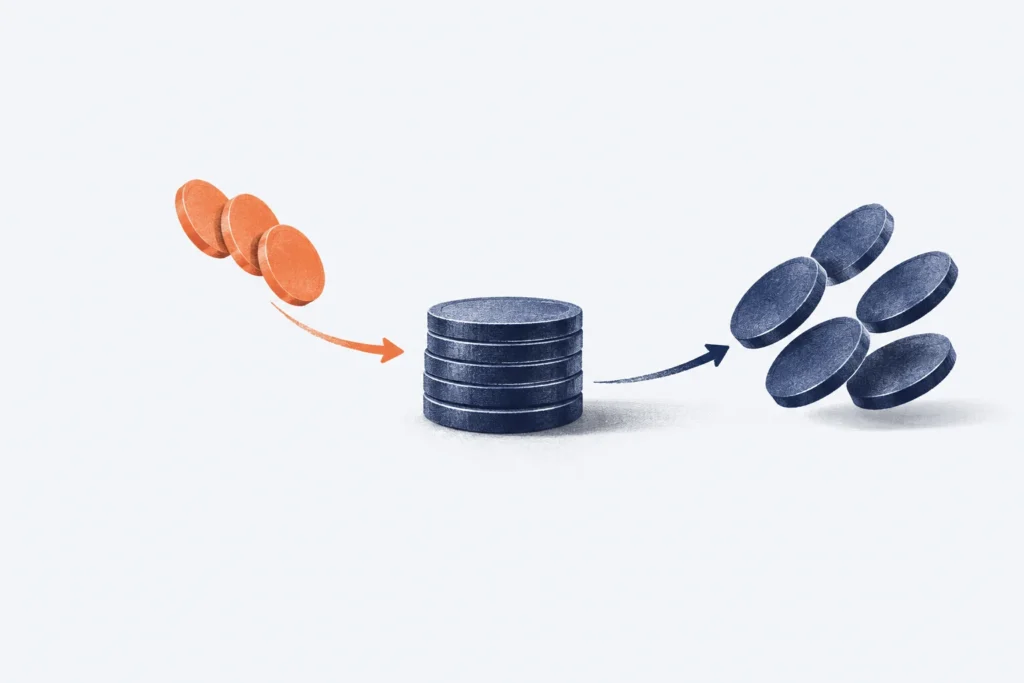
Work with the count of shares outstanding instead of the amount spent. Adjust the beginning share count to account for employee shares, shares withheld for tax, completed repurchases, and other equity transactions. The ending share count indicates whether the company has enlarged your stake; a decreasing share count means your stake has been increased. Then consider the cost of that result. I don’t consider a buyback attractive until both questions have been answered.[5]
Imagine I’m reading a buyback announcement over coffee, ready to put the spending figure into my spreadsheet. The snag is that the announcement gives dollars, while my ownership calculation needs shares. That mismatch irritates me just enough to leave the cell blank and open the equity footnote instead. A large check isn’t the same thing as a larger stake.
Follow the shares that actually changed hands
Open the statement of shareholders’ equity and the equity, compensation and repurchase notes in the 10-K and 10-Q. You want to reconcile beginning shares issued or withheld, plus completed repurchases, with ending shares, and other equity transactions. Keep dates and share classes consistent: a cover page count dated after quarter end does not reconcile to a quarter end bridge. Other equity transactions can change the total, but if equity issuance has already been net of withholding, do not subtract withholding again.[1][2]
As a comparative example, AMD’s Form 10-Q for the quarter ending June 27, 2026, provides the following information. These are share movements for a six month period, millions, rounded, and not a reconstruction of employee share settlements.[1]
| Share movement | 2026 six-month period | 2025 comparable period |
|---|---|---|
| Beginning shares outstanding | 1,630 | 1,622 |
| Employee-plan issuance | +4 | +4 |
| Shares withheld for employee taxes | , 1 | 0 |
| Program repurchases | , 1 | , 12 |
| Acquisition issuance | 0 | +8 |
| Ending shares outstanding | 1,632 | 1,622 |
The 2025 count was flat at 1,622 + 4-0, 12 + 8 = 1,622. Flat equity for employees was not the only offset to repurchases. Acquisition issuance was also an offset. In 2026, 1,630 + 4-1, 1 + 0 = 1,632, and your unchanged holding represented slightly less ownership. The relative change was (1,630 ÷ 1,632), 1 ≈, 0.12%. Note, these are rounded inputs, and the offsetting percentage is an approximation.[1][5]
An authorization is permission to buy, not evidence of purchases. Use completed transactions and their share counts. Also distinguish shares outstanding from shares issued: buying shares into treasury reduces outstanding shares even before formal retirement. Retiring those treasury shares later doesn’t reduce outstanding shares a second time. I like a bridge that adds up, but only if it adds up for the right reason.[1]
Compensation dollars aren’t delivered shares
Compensation expense measures an accounting cost, not the period’s share issuance. Salesforce’s fiscal 2026 filing illustrates the distinction: relevant equity awards are measured at grant-date fair value, with expense recognized over service periods, while award tables separately report grants and vesting. This year’s expense can therefore relate to awards granted earlier. Dividing it by today’s share price won’t tell you how many shares employees received.[2]
Awards represent potential future claims. Vesting satisfies the conditions of an award. There are many reasons that affect the final claim, including performance, option exercise, withholding, forfeiture and settlement terms. Expense recognition is not a shortcut to the final claim.[2][4]
Let’s say there’s a settlement of 100 RSUs at $100 each. If the company withholds 30 shares for employee taxes, the employee gets 70 shares and the company remits $3,000 to the tax authority. A gross bridge shows +100-30; a net issuance line shows +70. Subtracting another 30 from that net line would account for a share reduction. This is information I don’t want you to miss: withholding limits the shares delivered, but the company still pays cash.[3][4]
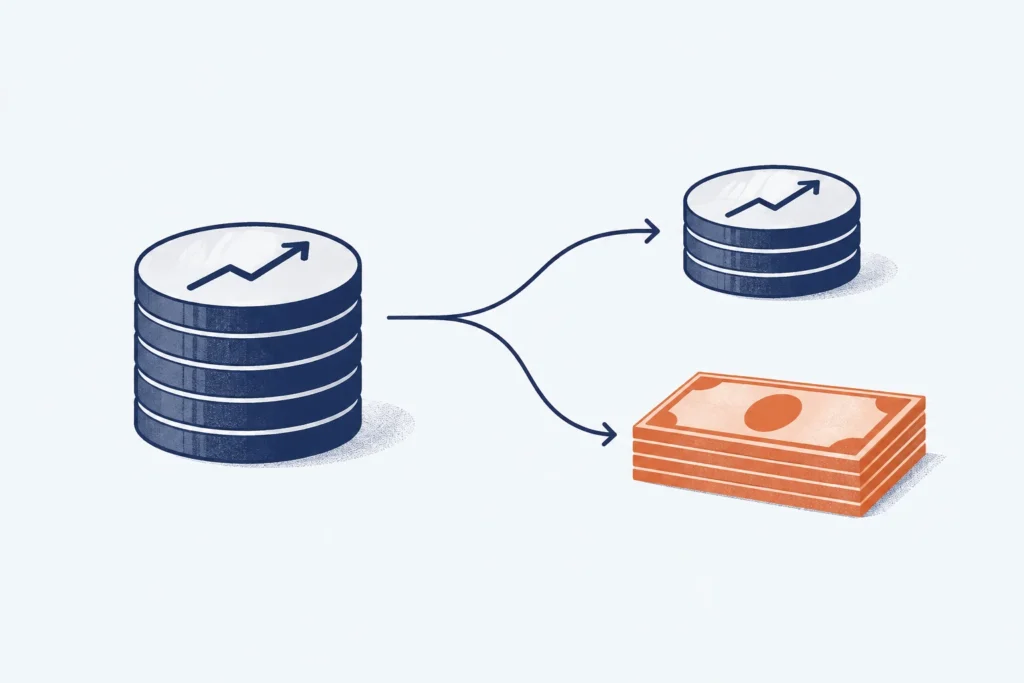
Not all filings disclose gross pieces separately. Use the net disclosures, and don’t guess to fill in the gaps. You can still determine the total change in ownership, and you may not be able to associate each share to a specific award type.
The EPS denominator answers a different question
The shares that are outstanding at the end of a particular period, indicate your ownership at that point in time. Basic shares, on the other hand, are weighted average shares for the period, and reflect the average length of time shares were outstanding during the period. A buyback that happens close to the end of the period can reduce the end of period shares, but may not impact the average. The two should not be viewed as competing figures.[1][4]
Diluted weighted-average shares, similar to basic weighted-average shares, assume the average shares outstanding during the period were repurchased. If awards are antidilutive, they are excluded, even if the company is loss-making, there can be no difference between basic and diluted EPS, while the company may have equity claims for the future. Read the award note and the EPS note; neither replaces the outstanding share bridge.[4]
Put the ownership result beside its cash bill
AMD’s disclosed cash components for the 2026 six-month period give a separate calculation, in millions: $5,321 operating cash flow, $1,197 cash capital expenditures, $341 employee withholding payments, $221 program repurchases + $205 employee-plan proceeds = $3,767 before other uses. The subtraction signs matter: withholding and repurchases consume cash, while employee-plan proceeds bring cash in. Employee withholding remittances are financing cash flows under the relevant US GAAP guidance, not the company’s own income-tax expense. You’ll miss that cash outflow if you stop at operating cash flow minus capex.[1][3]
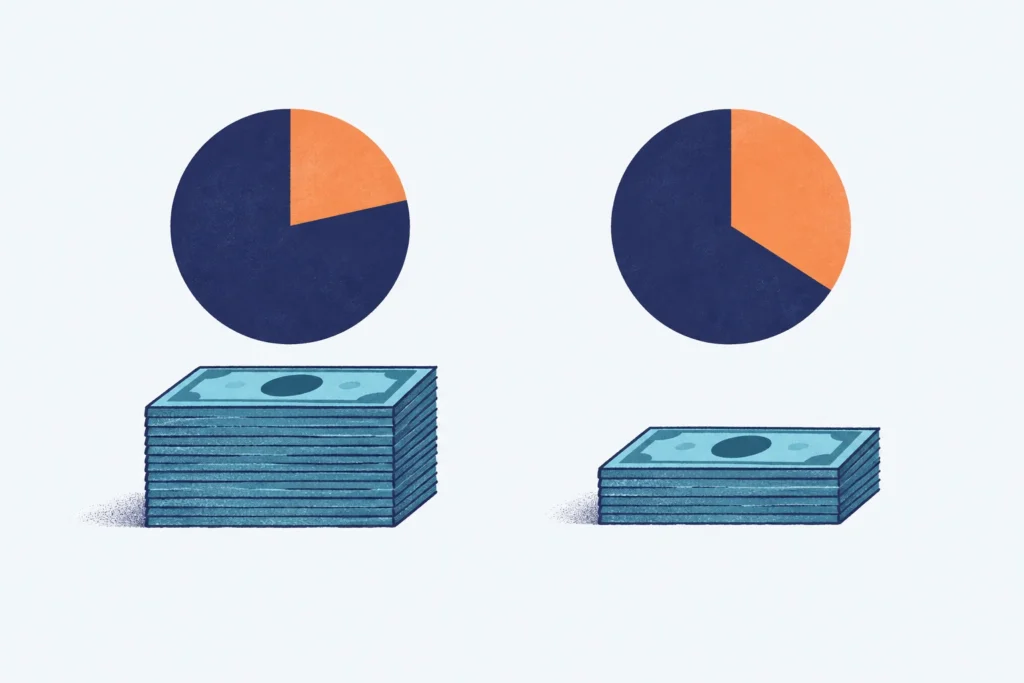
$3,767 is probably not a recurring repurchase budget. Flattering working capital cash flows are a timing issue. Cash flows need to pay for cash flows, e.g. repurchases. Long-term obligations, funding commitments, cash flow inadequacy, and operating liquidity still need to be funded. Are declining cash flows, borrowing, and equity issuance financing a shrinking stake? Maintaining a stake is beneficial, but expensive.[1][5]
When you move to valuation from the cash budget, you can assume future equity compensation is an economic cost. Alternatively, you can keep the add-back to cash flows and future equity compensation claims, including cash-funded repurchases if you assume dilution will be offset. Both approaches can be internally consistent and reconcile. Reported SBC expense is not necessarily a claim’s future value.[5]
The trap is deducting an economic cost for future grants and then charging for those same grants again through dilution or offsetting buyback cash. That bills shareholders twice for one employee claim. Subtracting actual repurchases and withholding in a historical cash budget is different: you’re recording payments that really occurred, not assigning a second valuation cost.[5]
A falling share count answers the ownership question, not the price question. Compare the repurchase price with your estimate of business value, and look at earnings growth separately from EPS growth: fewer shares can lift EPS without better operations, while the purchase consumes cash or adds debt. I’d rather see modest net share reduction at a defensible price, with investment needs funded, than a huge spending figure presented as though every dollar enlarged your stake.[5]
Sources and references
- Advanced Micro Devices, Inc.: AMD Form 10-Q for the quarter ended June 27, 2026 (2026-08-05)
- Salesforce, Inc.; filed with the SEC: Salesforce fiscal 2026 Form 10-K (2026-03-02)
- Deloitte: Heads Up, FASB Simplifies the Accounting for Share-Based Payments (2016-04-21)
- Deloitte: Earnings per Share Roadmap, 4.2 Treasury Stock Method
- Morgan Stanley Investment Management: Counterpoint Global Insights, Stock-Based Compensation
