

Stock options and restricted stock are forms of pay for service. Stock-based compensation reduces reported earnings by the compensation expense, but ownership is transferred when stock is vested. The cash flow add-back does not eliminate that cost.[1][4][5]
I would reflect compensation either by reducing cash available to shareholders, or by providing ownership to employees, and consider the effects of pending awards, and not charge the same awards twice.
The apparent contradiction is that earnings, operating cash flow, and diluted earnings per share measure different aspects of a business.[1][2][4]
The expense isn’t the eventual settlement bill
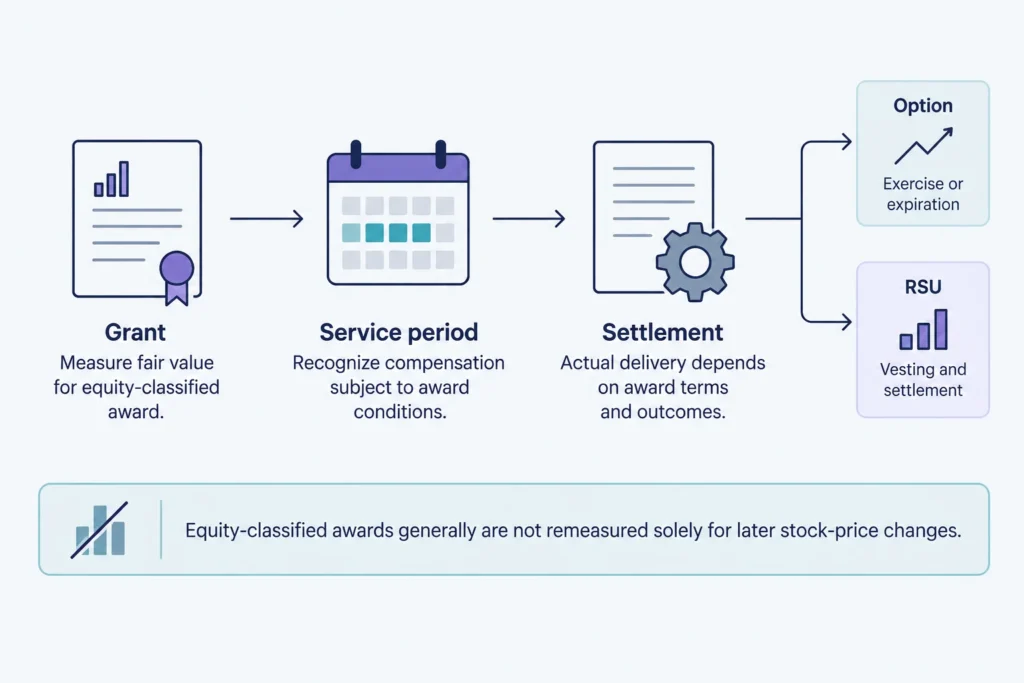
Under US GAAP, equity-classified employee awards are generally charged by the grant-date fair value, and recognized over the required service period. The expense recognized reflects service performed. Forfeitures, performance conditions and changes to the terms and conditions of awards impact when and how much of the expense is recognized. Therefore, the grant date measurement does not mean the original estimate is irreversible.[1]
An option gives the employee a right to buy shares at an exercise price. Its grant-date value depends on assumptions including expected term, volatility, dividends, and interest rates; it isn’t simply the stock price minus the exercise price. Restricted stock is stock issued with restrictions. A restricted stock unit, or RSU, is a contractual promise of future settlement, often in shares, rather than necessarily an already-issued share. Ordinary equity-classified restricted awards generally start from the underlying stock’s grant-date value, adjusted for relevant terms.[1][6]
Settlement can look quite different. Options may expire without exercise; RSU deliveries may depend on continued employment or performance targets. The stock price may also move sharply after grant. Recognized compensation isn’t reversed merely because a vested option expires unexercised: the employee already supplied the required service. Conversely, liability-classified awards are generally remeasured through settlement. Classification follows the contract’s terms, not just its label.[1]
Diluted EPS isn’t a delivery forecast
There are four separate quantities in equity-settled awards: shares outstanding on the valuation date, weighted-average basic shares outstanding during the reporting period, shares diluted under the EPS, and shares ultimately delivered under the awards. Earnings per share uses a period-weighted denominator. Only under certain conditions, in accordance with the equity method rules, and if dividends are payable on unvested awards, will earnings need to be allocated to both classes.[2]
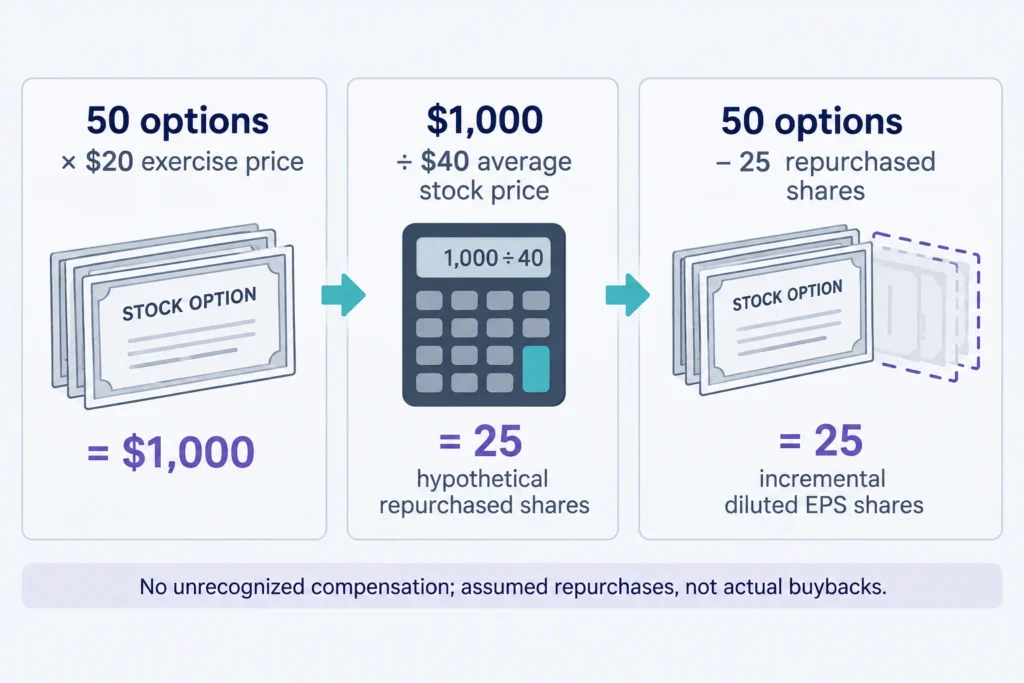
For a simple treasury-stock-method illustration, suppose 50 fully vested options have a $20 exercise price, the period’s average stock price is $40, and there’s no unrecognized compensation. Assumed exercise produces $1,000, which hypothetically repurchases 25 shares at $40. The incremental diluted denominator is therefore 25 shares, not all 50 shares that exercise would issue. Unvested awards can also have assumed proceeds from average unrecognized compensation. These are accounting assumptions, not actual buybacks.[2]
Snowflake’s 2026 filing illustrates the problem. For the year ended January 31, 2026, the weighted average shares used in the basic and diluted computation was 337.493 million. Snowflake’s loss-period calculation excluded antidilutive securities, including 21.537 million RSUs and 13.766 million options. Equal basic and diluted denominators didn’t mean employee dilution had disappeared; excluding them from the calculation would have reduced the loss per share.[3]
The cash-flow add-back answers a narrower question
For the same fiscal year, Snowflake’s operating cash flow reconciliation added back $1.599547 million of stock-based compensation, net of capitalized amounts. The reconciliation removes a noncash charge from net loss to determine operating cash flow. It doesn’t mean employees worked for free, and the amount isn’t the market value of the shares delivered.[3]
In another imagined example, where I’m looking at two software companies, and have a filing open next to my spreadsheet, I compare the two companies to analyze each one’s cheapness. One of the companies looks cheaper after I adjust the cash flow number. Then I see an employee compensation add-back and an unadjusted share count assumption, and my neat comparison bothers me. I leave the multiple as is and first determine where the employee payment belongs in the model.
My preference is to retain a normalized compensation cost when forecasting cash available to investors. If you start with operating cash flow less capital spending, the noncash compensation add-back is already there; you need an explicit adjustment to retain that labor cost. Historical grant-date expense can inform the estimate, but it isn’t an observable cash salary replacement cost. Taxes and capitalized compensation also need consistent treatment.[1][4]
Alternatively, you can leave compensation added back and explicitly model the ownership employees receive. That requires grant timing, vesting, settlement prices, option exercise proceeds, and ownership at the end of the forecast. It’s more demanding than dividing by today’s diluted EPS denominator. Options also have time value, which a simple count of currently in-the-money shares can miss.[4][5]
Same employee payment, two consistent answers
Let’s keep this extremely simple and just look at one period. We start with 100 shares, and prior to employee compensation, there is $120 available. There’s no debt, taxes, prior awards or other business value remaining. Employees can receive $20 in cash or 20 shares which participate in the final distribution. The employee payment is equal by construction, not because accounting expense always equals settlement value.
| Treatment | Calculation | Value per original share |
|---|---|---|
| Cash-cost treatment | ($120, $20) ÷ 100 shares | $1.00 |
| Ownership treatment | $120 ÷ (100 original + 20 employee shares) | $1.00 |
| Omit compensation | $120 ÷ 100 shares | $1.20 |
| Charge the same payment twice | ($120, $20) ÷ 120 shares | About $0.83 |
Using the ownership treatment, employees receive $20 and the original shareholders receive the remaining $100. Using the cash-cost treatment, employees receive $20 and original shareholders split the remaining $100. Here we have a useful reconciliation. Ignoring both treatments would overstate shareholder value, and using both treatments here would understate shareholder value.
Outstanding awards need their own reconciliation
Public companies have awards granted before your analysis date and grants they will make in the future. Normalizing for grants does not always cover opening employee claims. Damodaran's valuation treatment distinguishes compensation in forecast cash flows from outstanding options. For outstanding options, capturing the claim can better illustrate exercise proceeds and time value than simply counting shares outstanding.[4][5]
The tricky case is unvested opening awards. These may require future service, and their remaining accounting expense is already in your forecast. If you value these claims separately, you must reconcile the remaining amortization and service requirement, as opposed to simply eliminating both from your calculation. This is the reason why compensation expense in the numerator plus employee claims in the denominator is not automatically double counting. You need to specify which awards each adjustment relates to.[1][4][5]
I would write a short note next to each adjustment to indicate future employee service, opening vested options, and opening unvested awards, reconciled to the remaining expense. The award rollforward and EPS reconciliation would support the amounts and the cash flow statement the method of exclusion. If you cannot tell where the cost of a given award is captured, the valuation is not ready, even if the numbers produced give you a precise figure.
Sources and references
- EY: Financial Reporting Developments: Share-based payment (2026-07-29)
- EY: Financial Reporting Developments: Earnings per share (2026-07-08)
- Snowflake Inc.; SEC EDGAR: Snowflake fiscal 2026 Form 10-K (2026-03-20)
- Aswath Damodaran, NYU Stern: Valuation session 14 slides
- Aswath Damodaran, NYU Stern: Management Options and Value
- CFA Institute: Employee Compensation: Post-Employment and Share-Based
